Charter for Responsible AI in Animal Welfare
Summit Convened by: Best Friends Animal SocietyFounding Academic Partner: Southern Utah UniversityOctober 14, 2026




As with other transformative technologies, the rapid growth of artificial intelligence (AI) is ushering in a new chapter for animal welfare, one that brings both promise and risk.
This Charter is animal welfare's commitment to shaping how AI is used so that it advances animal welfare and lifesaving, strengthens the human-animal bond, supports the people doing the work, preserves the trust of the communities we serve, and advances strong partnerships across the field.
How we choose to use AI today will define animal welfare’s capacity to serve for decades to come. Inaction at this pivotal moment is not a neutral stance. It is a choice with consequences, and it risks leaving animals, communities, and the people who serve them behind.
This Charter does not mandate that every organization use AI. It also does not prescribe a single approach. It provides organizations that choose AI a clear, practical foundation for doing so responsibly, without requiring specialized staff or costly infrastructure. These commitments are intended to be useful and adaptable across organizations and communities with different missions, sizes, resources, staffing, governance structures, data, and technical capacity.
The Charter is designed to maximize positive impact while mitigating risk for individual organizations, for the field, and for the people and animals who depend on us. It is a living framework that must continue to evolve as the technology, the field, and our understanding of AI’s impacts change.
For the purposes of this Charter, AI refers to systems and tools that use data and other forms of information to identify patterns, generate or adapt outputs, make predictions, and increase human efficiency or capacity. These systems and tools include machine learning, generative models, and predictive algorithms. In this Charter, animal welfare includes animals in shelters, rescues, homes, and communities, along with the nonprofit and municipal organizations, staff, and volunteers who care for and serve them.
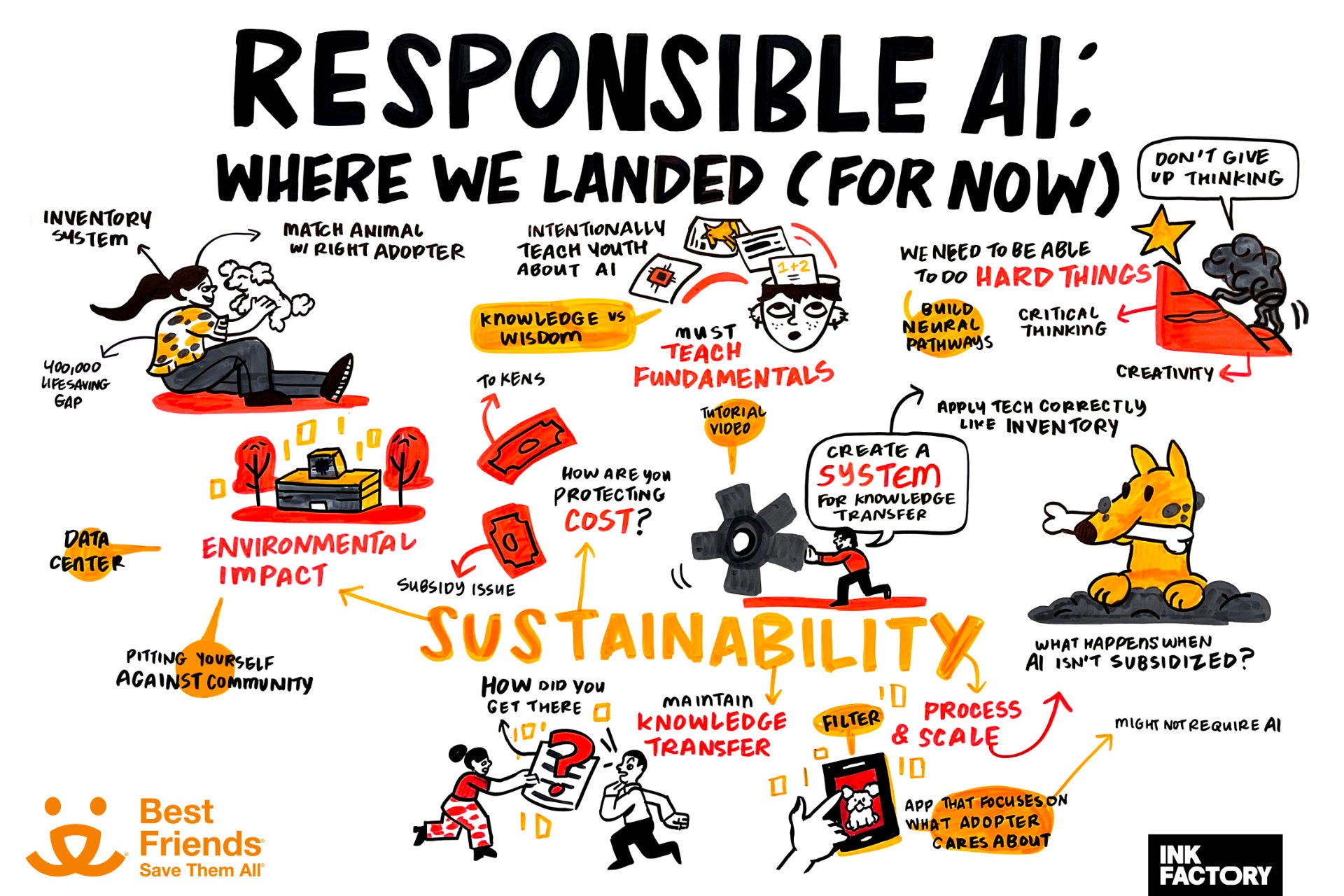
Our approach to responsible AI in animal welfare is built on eight commitments:
Animal Lifesaving and Welfare
We use AI in ways that advance animal welfare and lifesaving in shelters, homes, and communities. This includes expanding mission impact, improving access to care and support, removing barriers, strengthening collaboration, protecting public health and safety, supporting the people doing the work, and keeping people and pets together.
Humanity
We keep people and animals at the center of what we do. We honor human-to-human connection, the human-animal bond, and the well-being of the people who serve animals. We look for and address bias and inequity, and design for people, communities, and organizations with different languages, abilities, resources, and access to technology.
Integrity
We value and protect privacy, consent, transparency, and trust. We consider potential harms before using AI, including unintended harm. If harm happens, we identify it, are open about it with our community, take steps to limit it, and do what we can to make it right. We protect personal and organizational information. We preserve authenticity and when AI meaningfully shapes content, services, recommendations, or outcomes, we are honest about it.
Oversight
We use AI to inform and support (never to replace) human judgment, compassion, expertise, and critical thinking. We set clear rules for tasks, processes, and recommendations that require human review. Humans keep authority over high-impact decisions affecting animals and people, including medical treatment, behavioral disposition, placement, and outcomes.
Accountability
Our organizations, and the people in them, stay responsible for how AI is chosen, set up, used, and monitored. We are also responsible for the results it produces. This requires identifying accountable people and establishing appropriate review and feedback processes. It also requires acting when outputs or outcomes are inaccurate, harmful, or fall short of these standards. We ensure people have clear ways to question, correct, or escalate AI-supported outputs to a human.
Intentionality
We choose AI only when its expected value justifies its full costs and impacts. We start with a clearly defined problem. We consider whether a simpler tool could get the job done. We name the result we want, who will benefit, who may face risks, and how we will measure success before determining AI is the right fit.
Adaptability
We watch how well AI is working, monitor for unintended effects, and revise or discontinue uses when needed. We learn from how other organizations use AI and openly share our own successes and failures to strengthen the whole field.
Sustainability
We account for the full cost of AI across its whole lifecycle and its cost per use, particularly as pricing and subsidized access change. We avoid depending on tools we cannot sustain, and we keep the skills, knowledge, and non-AI processes needed to operate without them. We weigh the energy, water, and other effects on communities and the natural world against the value AI creates.
A Living Charter
These commitments require continued stewardship. The Charter should be reviewed on a regular schedule. That review should include organizations of different sizes, roles, regions, communities, and levels of technical capacity. Future versions should be shaped by evidence, real-world experience, community feedback, and changes in technology. They should also reflect the views of the people and animals most affected.
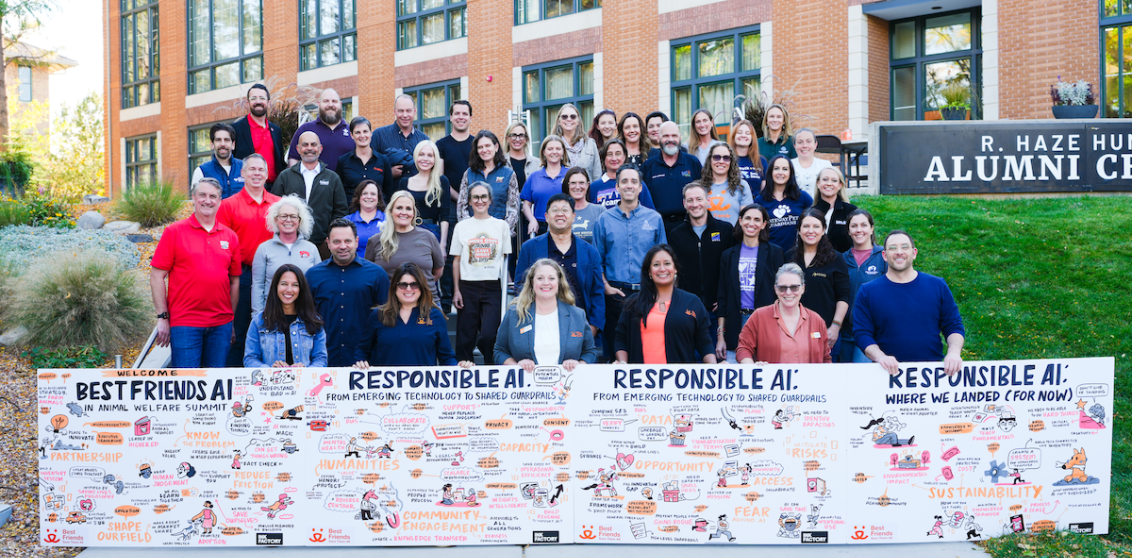
AI in Animal Welfare Summit Attendees











Aaron Klein | Aaron Lamstein | Abigail Appleton | Aimee Charlton | Alicia Figueiredo |
Alisha Vianello | Alyse Arras | Amanda Foster | Amy Davila Sanchez | Amy Kohlbecker |
Anastasia Nesbeth | Angelita Sampaio | Bethany Heins | Cathy Hart | Christa Chadwick |
Cynthia Pena | Daniel Hill | Danielle Bolen | David Hatch | Dr. Diane Darling |
Doug McCrea | Elizabeth Bennett | Evan Brown | Holly Sizemore
| James Sage |
Dr. Jennifer Kitchen | Jessica Arias | Jess Grand | Dr. JoAnn Bartley | Jonathan Sizemore |
Jordan Craig | Josh Fisher | Julie Castle | Dr. Julie McCown | Dr. Katherine Polak |
Katie Hutchinson | Laura Houston | Leslie Sans | Mary Pearson | Maureen Gillespie |
Melinda Pfundstein | Melody Jennings Bowers | Melynda Thorpe | Misty Valenta | Phil Chen |
Rachael Ziering | Rachel Golub | Regan Goins | Scott Trebatoski | Dr. Sean Murphy |
Shubber Ali | Steven Martinez | Sue Cosby | Talia Butler | Tanner Vario, MPA |
Dr. Travis Simkins | Whitney Bollinger | William Heyborne, Ph.D. | Zak Sprowls |
|