The 2027 Letters of Interest (LOI) submission window is closed. Decisions will be shared in early November 2026.

Grants for Animal Rescue to Save More Lives: The Rachael Ray Save Them All Grants
The Rachael Ray Save Them All grants fund projects that increase lifesaving of cats and dogs in U.S. shelters. We welcome project proposals from public and private shelters, as well as rescue groups and other animal welfare organizations focused on impacting lifesaving at shelters.
Learn more about the basics of the Rachael Ray Save Them All grants and hear from a grant recipient on the Best Friends Podcast.
Who Can Apply?
- Public and private shelters with a lifesaving gap (save rate below 90%)
- Public and private shelters, rescue groups, and other animal welfare organizations without a lifesaving gap whose project will be impacting a shelter that has a lifesaving gap (has not yet achieved a 90% save rate)
Other Eligibility Requirements
Please make sure you are familiar with the following requirements before applying:
- Organizations must be a part of the Best Friends Network
- Data-sharing requirements
- Shelter Pet Data Alliance (SPDA)-eligible organizations must submit monthly data for January 2025 through August 2026 to be eligible to apply for a grant.
- Submit 2025 annual community data for non-SPDA eligible organizations
- Programs must be implemented within the United States
- Awarded grant funds must be spent within a one-year period
What Types of Projects are Considered?
Projects can be focused on just one event/program or can include multiple events/programs.
Here are a few examples of previously funded Save Them All Grants:
- Implementing programs that provide pet retention services for the community
- Increase of Return to Field or Adoption via working cat program
- Providing advanced medical care for target number of at risk pets
- Return to home efforts expanded through waived fees
- Shelter enrichment for large dogs at-risk for kennel decline
- Transferring in at risk population (i.e. underage kittens, adult cats, large breed dogs) from a specific high need shelter
See the full list of grants awarded during our last cycle.
How Much Funding Can I Request?
Your organization can apply for a grant of up to $50,000, with the amount requested not exceeding 10% of your operating budget.
Letter of Interest (LOI) Information
This grant cycle, we will be collecting Letters of Interest (LOI) as the first phase of the grant cycle. When applying for the grant, there will be a short form that you will submit for the grant.
Below, are the questions that are included in the LOI form to help in your preparation.
- Which grant are you submitting a grant proposal for? (The Rachael Ray Save Them All, The Rachael Ray No-Kill Excellence, Not Sure)
- Project Name
- How would you identify your community? (Urban, Suburban, Rural)
- Have you previously applied for one of these grants in the past? (Yes, No, Not Sure)
- Amount Requested
- Note: No-Kill Excellence up to a maximum of $60,000 and not to exceed 10% of operating budget. Save Them All up to a maximum of $50,000 and not to exceed 10% of operating budget.
- Will you or a partner organization achieve a 90% rate or higher through this project?
- Lifesaving Gap Population Type(s)
- Lifesaving Programs
- What region is your organization located in?
- Where are your intended impact partners located?
- Impacted Partner Organization Names
- Project Summary and Implementation Timeline
- The number of animals benefited by your grant project
- Note: Do not double count animals or estimate indirect impact in your calculations. For example, managing and diverting intakes of 50 cats cannot also be counted as 50 community cat programming.
Once LOIs have been reviewed, should your project be of further consideration, you’ll move onto the second phase where you will be invited to submit a full application for funding consideration.
Reporting
Grant recipients will be assigned reports via our grant management platform. Emails are sent to the assignee as reports are assigned.
Please read the following reporting requirements carefully as failure to submit timely and accurate reports on the progress of your project can impact the ability to receive future funding.
If the reports should be assigned to someone other than the person who submitted the application, please email RRFGrants@bestfriends.org.
Quarterly Reporting
Quarterly reporting requirements include providing the number of impacts (Transfer/Transport, Foster Programming, etc) you have completed with the awarded funds. We also ask you to provide a brief update on how your project is progressing, as well as a story and photo from your project.
- Amount of funding spent through report date
- Impacts depending on project type, attributed to the funds awarded. These include, by species (see definitions here):
- Transfer/Transport
- Foster Programming
- Managing and Diverting Intakes
- Medical Programming
- Community Cat Programming
- Pet Retention/Safety Net Programs
- Return-to-Home Programming
- Adoption Programming
- Behavioral Programming
- Is your organization current on their data?
- If you have impacted shelters as part of your grant, to the best of your knowledge are they current on their data?
- Summary of Progress
- Success Story and Photo
- When your grant is complete, you will also be asked to provide:
- Project Successes
- Project Challenges
- Testimonial
We reserve the right to identify additional reporting metrics appropriate to the scope and impact of the project.
Frequently Asked Questions
What is a lifesaving gap?
A community is considered to have no lifesaving gap when every brick-and-mortar shelter located within the county has a save rate of 90% or higher.
The lifesaving gap is the number of cats and dogs who would have had to be saved last year in order to achieve the 90% save rate threshold.
If your project is funded, Best Friends will do the calculations to determine the reduction in lifesaving gap for you using the data for each shelter your project impacts that you provide to us each month.
If you are curious how we do it, visit our How No-Kill is Calculated page.
Are projects implemented in and/or impacting U.S. Territories eligible for grant funding?
No, at this time our grant opportunities are not open to U.S. Territories.
Can I apply for both an STA and NKE grant?
No, your organization will only be allowed to submit for one grant.
Can I apply for a grant if my organization has another grant in progress?
Yes, you can apply, but we will consider the following:
- Progress made to date- are you on track to complete your open project on time?
- Grant progress reporting compliance for both monthly (as applicable) and quarterly reports.
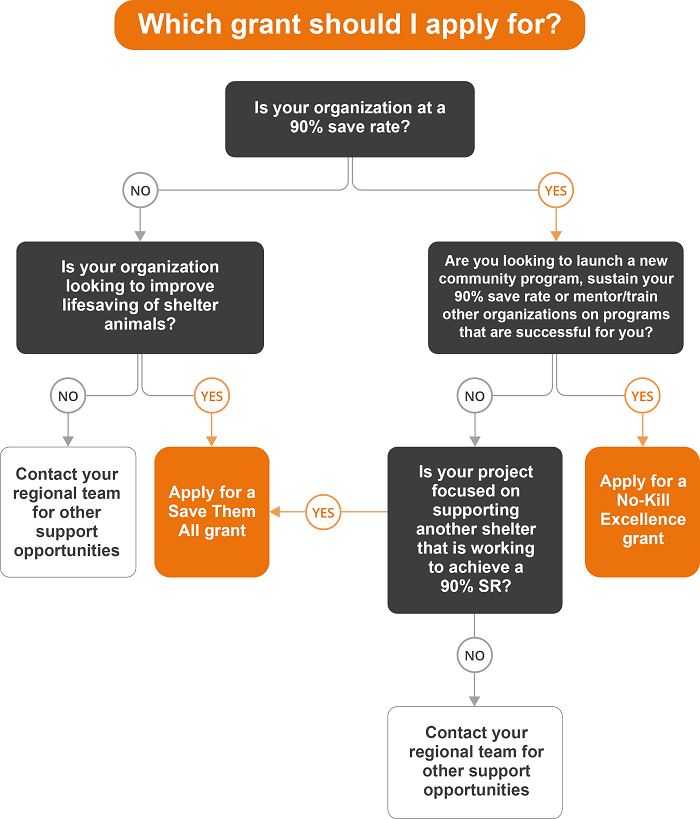
How do I know which grant type my organization should apply for?
See our chart to help guide you in making a decision.
What does it mean get the data for impacted shelter(s) if I’m not the shelter impacted?
This means obtaining the intakes and outcomes stats for January 2025 through August 2026, broken down monthly, for any shelter(s) other than your own that will be impacted by your project.
- If funded, you will be required to provide these stats for each impacted shelter, broken down monthly, for the remainder of 2026, as well as for the duration of your grant project.
- Click here for additional information on recipient reporting requirements.
I have the shelter data. How do I know who to help?
Talk to shelter leadership, they will know who it is they’re struggling to help.
- Seek to understand what it is they need or don’t have that if they did, would provide a specific population of cats or dogs live outcomes when possible.
You can also look at the Shelter intake and Shelter euthanasia numbers. Ultimately the goal of the funding is to see less of a specific population of animals euthanized for preventable matters.
- Who is being euthanized currently and why? OF those animals euthanized for lack of space/time/resources or support, targeting a project to provide such elements is what this grant opportunity is seeking.
Do I have to provide data for both cats and dogs if my project will only impact one of the species?
Yes, in order for us to calculate the impact of your project on the lifesaving gap at your own shelter or impacted shelter(s), we need monthly data for both cats and dogs.
Can I still apply if I’m not able to get an impacted shelter’s data?
We cannot fund projects that impact shelters for which data is unobtainable, but we might be able to assist.
- If you are running into challenges with obtaining data from an impacted shelter(s), please reach out to your regional team for guidance.
When will grant decisions be announced?
Applicants will be notified of a grant decision approximately by the end of December 2026.
Who can I contact if after reviewing all of the grant information on the website, I still have questions?
For questions about eligibility requirements or accessing/using our grant management platform, please reach out to RRFGrants@bestfriends.org.
Common Definitions
Live Intakes: Live cats and/or dogs admitted to a shelter.
Live Outcomes: Cats and/or dogs who leave a shelter alive through adoption, return to owner, transfer to another organization for adoption, or any other lifesaving. program.
Other Outcomes: Cats and/org dogs who did not leave the shelter alive.
Lifesaving Gap: the number of cats and dogs who would have had to be saved last year in order to achieve the 90% save rate threshold.
The calculation we use to determine lifesaving gap is:
(Shelter Deaths* + Lost in Care) – (Live Intakes x 10%)
* Shelter Deaths = animals euthanized, killed, or died in care
Impacted shelter: A shelter, other than the recipient, whose save rate or lifesaving gap will improve as a result of a project's funding.
Kitten intake diversion support: Organization or agency provides alternative to shelter intake for shelter without means to provide care for positive outcome opportunity.
Targeted TNR: projects such as funding to provide an alternative for community cats in lieu of shelter intake (where the org facilitates surgeries and return, avoiding the cat entering shelter OR an organization that assists a shelter with a positive outcome pathway for community cats in the shelter (facilitating pull, surgeries, and return). These are examples of TNR activities having a direct and measurable reduction shelter killing.
Stay Connected
Want the latest updates about future grant cycles? Sign up for exclusive email updates or reach out to your regional strategist for additional support.
Back to Main Grants Page | Back to Rachael Ray No-Kill Excellence Grants