A New Standard for Responsible AI in Animal Welfare


Increase return-to-home rates

Drive more adoptions

Build lifesaving momentum
Resource Library
Access proven lifesaving strategies in our free library of resources for shelters and rescue groups. Information-sharing is a key component of the Best Friends Network.


— NETWORK PARTNER STATISTICS —
Higher save rate on average for network partner shelters than non-partners.
Shelters, rescue groups, and support organizations make up the Best Friends Network.
In grants. This year, our partners can access more than $2.4 million in grant funding.
Get Involved
The Best Friends Network is committed to saving the lives of homeless cats and dogs through collaboration, information-sharing, and implementation of proven strategies. Get involved for free!


Opportunities to connect and save the lives of pets
Have fun and connect with fellow network partners and animal lovers at these upcoming events.
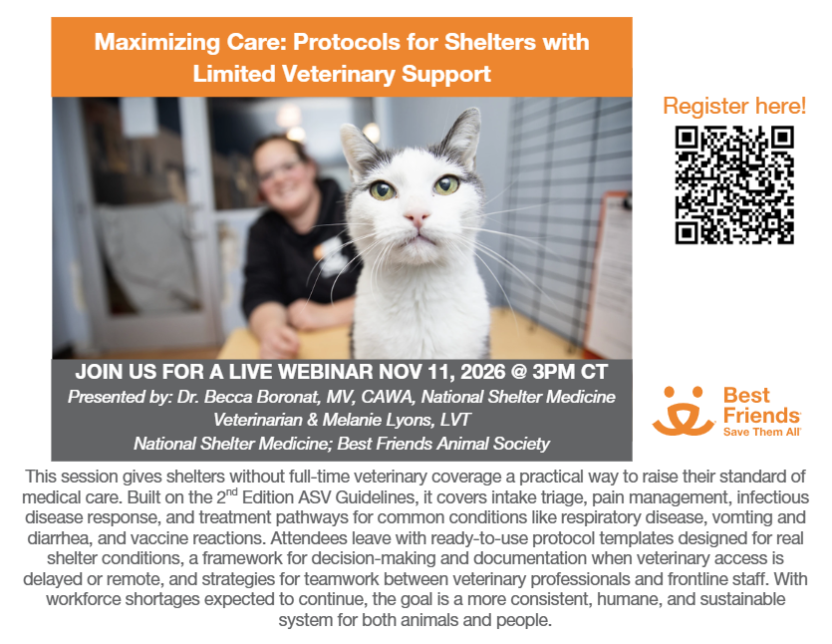
This session gives shelters without full-time veterinary coverage a practical way to raise their standard of medical care.
This session gives shelters without full-time veterinary coverage a practical way to raise their standard of medical care. Built on the 2nd Edition ASV Guidelines, it covers intake triage, pain management, infectious disease response, and treatment pathways for common conditions like respiratory disease, vomiting and diarrhea, and vaccine reactions. Attendees leave with ready-to-use protocol templates designed for real shelter conditions, a framework for decision-making and documentation when veterinary access is delayed or remote, and strategies for teamwork between veterinary professionals and frontline staff. With workforce shortages expected to continue, the goal is a more consistent, humane, and sustainable system for both animals and people.
Presented by: Dr. Becca Boronat, MV, CAWA, National Shelter Medicine Veterinarian & Melanie Lyons, LVT
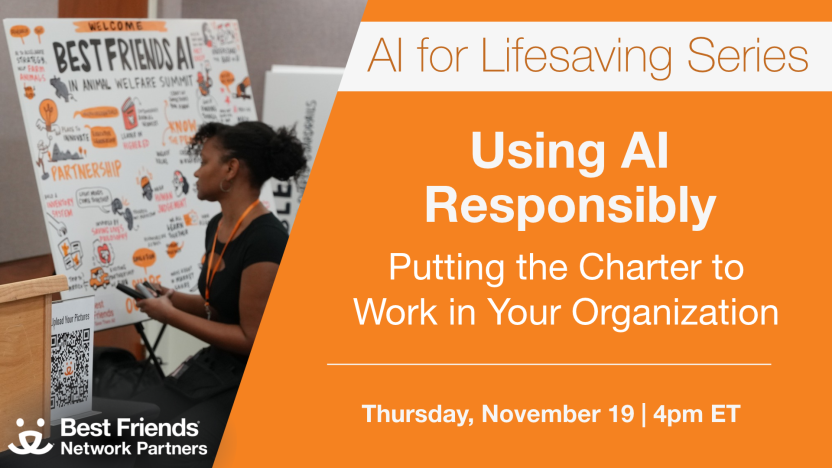
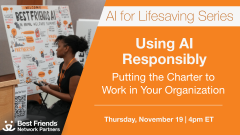
AI is already part of daily work at many shelters and rescues, from writing adoption bios and drafting board reports, to improving data analysis and refining operational procedures.
AI is already part of daily work at many shelters and rescues, from writing adoption bios and drafting board reports, to improving data analysis and refining operational procedures. But until recently, a shared set of standards to guide this rapidly evolving work did not exist.
With the goal of coming together as a field to shape how AI is used rather than waiting for developers to define it, shelter, rescue, and national animal welfare leaders, tech experts, and college faculty recently met at Southern Utah University to finalize the Charter for Responsible AI in Animal Welfare.
The Charter sets out eight commitments that give organizations choosing to use AI a practical foundation for doing so responsibly, without specialized staff or costly infrastructure. It does not require any organization to use AI or prescribe a single approach.
Register to join this discussion live on Thursday, November 19 at 4pm ET, and bring your questions.
Join moderator Whitney Bollinger, director of network strategy and innovation at Best Friends Animal Society, for a conversation with a few of the nearly 60 people who helped write the Charter: Dr. Sean T. Murphy, assistant professor of philosophy at Southern Utah University (SUU); Dr. Jennifer Kitchen, staff veterinarian and health informatics lead for CampLA; and tech and innovation advisor Shubber Ali.
The panelists will talk about how the Charter can work in very different settings, from a municipal shelter to a small, volunteer-run foster rescue. They will also discuss what each commitment asks of an organization, sharing the debates that shaped the Charter’s final language.
You’ll leave with an understanding of how to apply the Charter to your day-to-day work, whether you’re already using AI in your lifesaving or testing your first AI tool. We’ll save time for Q&A, and we want to hear what tools and resources we can create to support your utilization of the Charter. Save your seat and join live!

Get the support you need
The Best Friends Network team is your lifeline to support for your organization and collaboration with other network partners.
Let’s be friends!
Connect with us on social media to stay in the loop about the lifesaving progress we’re making together.


