A New Standard for Responsible AI in Animal Welfare


Increase return-to-home rates

Drive more adoptions

Build lifesaving momentum
Resource Library
Access proven lifesaving strategies in our free library of resources for shelters and rescue groups. Information-sharing is a key component of the Best Friends Network.


— NETWORK PARTNER STATISTICS —
Higher save rate on average for network partner shelters than non-partners.
Shelters, rescue groups, and support organizations make up the Best Friends Network.
In grants. This year, our partners can access more than $2.4 million in grant funding.
Get Involved
The Best Friends Network is committed to saving the lives of homeless cats and dogs through collaboration, information-sharing, and implementation of proven strategies. Get involved for free!


Opportunities to connect and save the lives of pets
Have fun and connect with fellow network partners and animal lovers at these upcoming events.
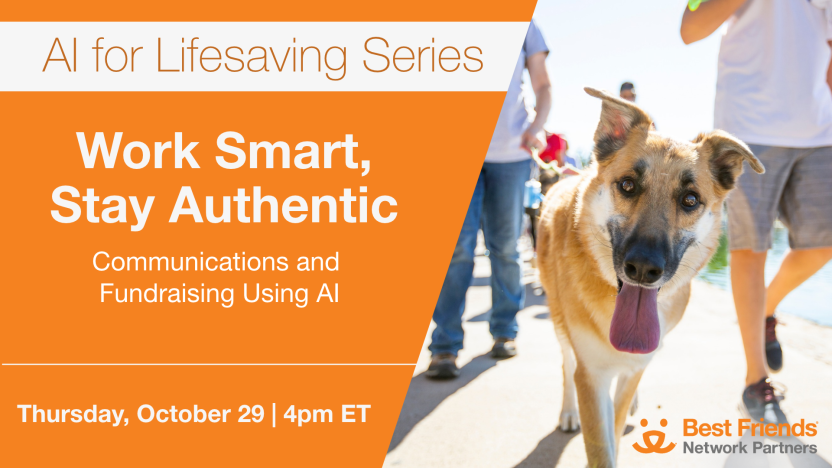
Your communications work runs on trust, a clear voice, and the relationships you’ve built over years.
Your communications work runs on trust, a clear voice, and the relationships you’ve built over years. AI can be a helpful tool for reaching supporters, energizing volunteers, raising funds, and getting more pets adopted. Used carelessly, though, it can wear down that trust.
You don’t have to feel overwhelmed, or alone, as you figure out where AI fits in your shelter’s or rescue’s communications and fundraising work.
Register to join this webinar live on Thursday, October 29 at 4pm ET.
Sue Citro, Chief Experience Officer for Best Friends, and Elissa Jones, Best Friends’ Senior Director of Communications & Creative Content, will explore how your team can use AI as a supporting tool while keeping your voice and values front and center.
You’ll gain actionable tips on setting guardrails that fit your organization’s voice, reviewing AI-generated content before it goes out, and ways to be open with your community about when and how you use this tool.
No technical background or big budget required. Whether you’re a one-person communications team, part of a larger staff, or a curious volunteer, you’ll leave with practical ideas to try right away and a clearer sense of which uses to skip. Save your seat today!
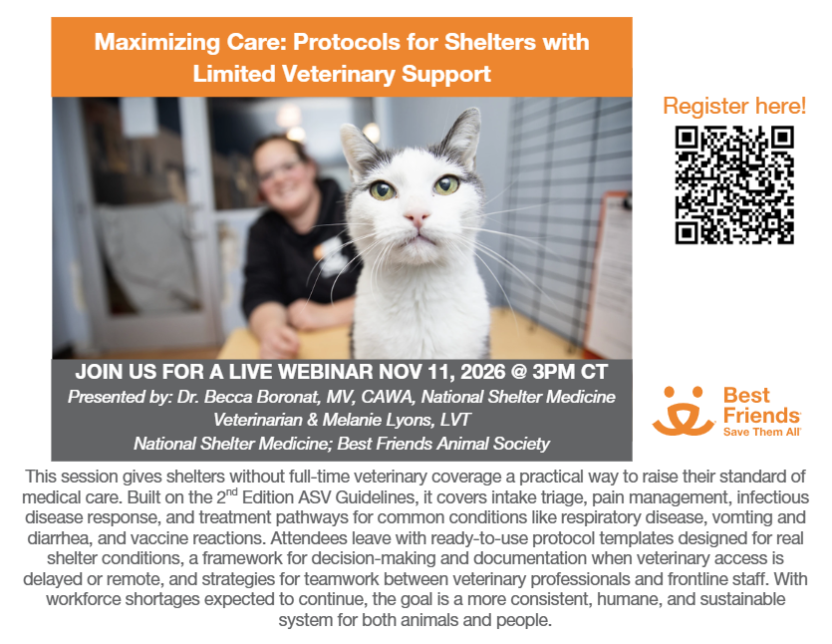
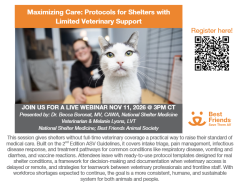
This session gives shelters without full-time veterinary coverage a practical way to raise their standard of medical care.
This session gives shelters without full-time veterinary coverage a practical way to raise their standard of medical care. Built on the 2nd Edition ASV Guidelines, it covers intake triage, pain management, infectious disease response, and treatment pathways for common conditions like respiratory disease, vomiting and diarrhea, and vaccine reactions. Attendees leave with ready-to-use protocol templates designed for real shelter conditions, a framework for decision-making and documentation when veterinary access is delayed or remote, and strategies for teamwork between veterinary professionals and frontline staff. With workforce shortages expected to continue, the goal is a more consistent, humane, and sustainable system for both animals and people.
Presented by: Dr. Becca Boronat, MV, CAWA, National Shelter Medicine Veterinarian & Melanie Lyons, LVT

Get the support you need
The Best Friends Network team is your lifeline to support for your organization and collaboration with other network partners.
Let’s be friends!
Connect with us on social media to stay in the loop about the lifesaving progress we’re making together.


