‘Concrete owl’ gets new wings and flies to freedom
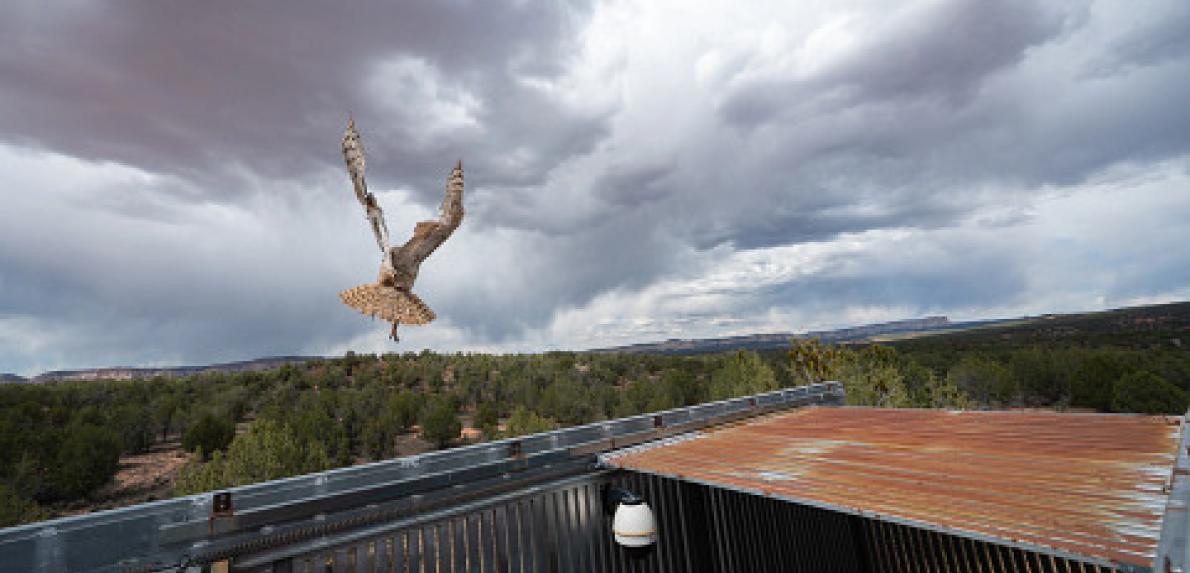
A young great horned owl originally found covered in concrete has flown to freedom after seven months of care at Best Friends Animal Sanctuary in Kanab, Utah, which is also the headquarters of national animal welfare nonprofit Best Friends Animal Society
The male owl, rescued by Best Friends Animal Society in late October after a good Samaritan found him in a concrete mixer approximately 80 miles away in St. George, required new feathers for silent flight, a necessity in the wild.
During his time at Wild Friends, a certified wildlife rehabilitation center based at Best Friends Animal Sanctuary, the Wild Friends team was waiting patiently for the owl to molt, which would have replaced the damaged feather naturally. However, his spring molt was not going as predicted.
That led the Wild Friends team to take a training course about a procedure they had never done before: imping, which requires using donor feathers and adhesive to replace the raptor feathers. Utah Wildlife Foundation gave Wild Friends feathers from a great horned owl of similar size who had passed away.
To prepare for surgery, the Wild Friends team kept track of the owl’s feather patterns. “We looked at his feathers every few weeks so we knew which ones would have to be done, snipping damaged shafts in advance,” said Bart Richwalski, Supervisor, Wild Friends, Best Friends Animal Sanctuary.
The imping took place on May 1, with three members of the Wild Friends team and Best Friends Animal Society’s staff veterinarian, Kelsey Paras. While the owl was under anesthesia, the team had a balanced approach to the 90-minute procedure.
The donor feathers had been laid out to replicate each wing, so the team could line up the replacement feather, cut it to the necessary length, line up, and adhere. Ultimately, 10 primary and one second feather were replaced in the owl’s right wing, while the left wing didn’t require any replacements.
“The first few feathers were extremely nerve-wracking, but as we got into the groove, the imping became more comfortable, and everything went smoothly,” Richwalski said.
Best practice after a successful imping is to release a bird into the wild as soon as possible once silent flight has been achieved, so the owl was placed in Wild Friends’ largest aviary to recover from anesthesia and allow for flight.
While being monitored, the owl was seen flying to the highest perch, so Richwalski went in to measure the sound of its wingbeat. Using a decibel reader, Richwalski determined that the owl’s flight was quiet enough for safe release. While the aviary roof slowly retracted, the owl hovered a bit before gaining speed, then flying straight up and out into the wild.
It was quite a full-circle moment for Richwalski, who has cared for the owl since picking him up in St. George through the moment he was set free.
“I don’t know that my heart was beating until I saw him leave. I was beside myself, knowing that after all this time, he was healthy and back in the wild,” he said. “It was such a good feeling.”
The owl’s remarkable journey has touched every level of the organization.
“Best Friends Animal Society believes that every animal has intrinsic value and the care that our team took with this owl really reflects that belief,” said Judah Battista, Chief Sanctuary Officer, Best Friends Animal Society. “I’m so proud of the Wild Friends team for their incredibly hard work to get this owl to freedom.”