Hurricane Katrina, 20 years later: What we saw, learned, and how animals fare better today
Twenty years ago today, Hurricane Katrina made landfall on the Gulf Coast and devastated New Orleans, as well as coastal areas of Louisiana, Mississippi, and Alabama. The storm itself was catastrophic, but it was the failure of the levees in and around New Orleans that turned Katrina into one of the deadliest natural disasters in U.S. history. Entire neighborhoods were swallowed by water, an estimated 250,000 New Orleanians were displaced, nearly 1,400 people lost their lives, and upward of 70,000 animals were left stranded and died in the chaos.
As waters began to rise and the levees failed, no one could yet grasp the scale of what was happening. But we knew one thing: The animals couldn’t wait for formalities — they would need us immediately.

On August 29, 2005, when Katrina made landfall in Louisiana, Best Friends staff were already on the move.

Thanks to close ties with leaders of local animal agencies in Jefferson and St. Bernard parishes, our team bypassed the bureaucratic gridlock that kept many national groups waiting nearly a week for federal approval. While others waited for clearance, we launched our rescue efforts immediately.
We were on the ground on August 30.
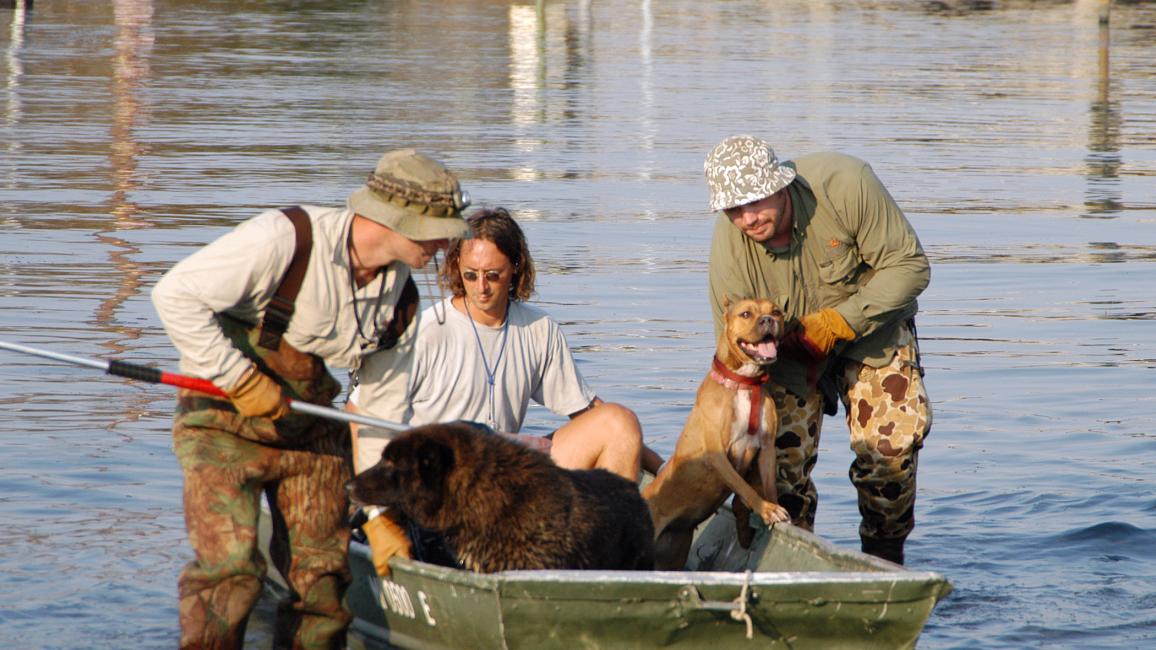
We began our work with Jefferson Parish evacuees, taking on the task of managing pets of residents being evacuated by bus. Then, within 48 hours, our team was rescuing stranded animals from the floodwaters.

The most jarring problem was that no official evacuation plan in the U.S. accounted for pets. Emergency shelters for human evacuees refused to allow pets, and search-and-rescue teams would not allow stranded individuals to bring their pets along on truck, boat, or helicopter evacuations, forcing people — sometimes at gunpoint — to leave their pets behind if they wanted to seek safety. Homes were totally underwater. People had no place to go and no choice but to leave their pets behind in order to gain shelter.

Our rescuers captained flatbottom boats and made their way through flooded neighborhoods. They were often sent to retrieve a pet at a specific address, only first to come across animals clinging to rooftops, or stranded on top of cars, or swimming desperately toward the boat. The rule was simple: Help the animal in front of you first; then race daylight to get back to the original call.

I’ll never forget my initial experience on the ground after Hurricane Katrina. At the time, I was based in Salt Lake City as the executive director of our statewide no-kill coalition, No More Homeless Pets in Utah. I knew that I had to get down there, so I rented a van, drove to New Orleans, and helped evacuate 65 cats from a sanctuary that had been devastated.

It marked a before-and-after moment in my life. I’ll never, ever forget it.
Over the next nine months, more than 2,000 volunteers deployed through Best Friends and helped to save more than 6,000 animals — cats and dogs, yes, but also iguanas, turtles, ferrets, pythons, fish, and an emu.


We set up an emergency rescue shelter thanks to the generosity of Pam Perez, founder of St. Francis Animal Sanctuary in Tylertown, Mississippi, and with the help of Rebecca Guinn, founder of LifeLine Animal Project in Atlanta. That emergency shelter became the hub of our operations, where those thousands of animals were cared for and rehabilitated by our staff and volunteers in the field. Meanwhile, at Best Friends Animal Sanctuary in Kanab, Utah, staff and volunteers set up makeshift offices and workstations wherever space allowed, answering calls for help and maintaining communication with our team on the Gulf Coast.


Every day at that Tylertown emergency shelter, animals arrived by the truckload. Come December, we had set up a second emergency shelter at an out-of-business Celebration Station amusement park in Metairie, Louisiana. Our work covered the expansive area affected by Katrina and was only made possible by the volunteers who dropped everything to be there and help out. Volunteers hauled supplies, worked miracles in makeshift veterinary clinics, searched abandoned homes, coaxed terrified dogs out from under collapsed porches, tracked stray animals, and set traps to bring them to safety. Our search-and-rescue team was still finding and rescuing animals from the devastation as late as February 2006.


Katrina was the full-time focus of Best Friends until May 2006, when our last team members finally returned home. It wasn’t just rescue; it was commitment. We stayed because families were still looking and animals were still waiting.


Katrina also laid bare something undeniable: Pets are family.
In 2005, no evacuation plan accounted for pets. “No pets allowed” was the rule in shelters, on buses, even on the boats and helicopters pulling people from rooftops. Because of the levee failures brought on by Katrina’s strength, families were forced to make the most agonizing choice possible: Leave with their lives, or stay with their pets.

One story that gripped the nation was of a young boy, crying as his dog, Snowball, was taken from his arms before he boarded an evacuation bus. That moment became a symbol of everything that was wrong with the system, and the public outrage that followed made change inevitable.

Out of heartbreak came transformation.
In 2006, Congress passed the Pets Evacuation and Transportation Standards (PETS) Act, requiring jurisdictions to have pet evacuation plans in order to qualify for FEMA funds. For the first time ever in federal law, pets were given distinct recognition as more than property — they were family. Best Friends, along with incredible partners, helped shape that legislation, drawing directly from what we lived in New Orleans.

Katrina also reshaped disaster response within animal welfare itself. We dynamically developed new protocols for sheltering, treatment, and reunification that became models for future responses. We built a coalition of partners who shared our values, ensuring that no community’s own animals were killed to make space for Katrina pets. We refused to leave just because the “official” emergency was declared over. And we worked fast, with urgency guiding every decision, because lives depended on it.

These were the tenets of no-kill, lived out in real time on flooded streets and in makeshift shelters. And they became the foundation for every disaster response that’s come since.

Two decades later, disaster response for animals looks very different.
Evacuation plans now account for pets. Human shelters and rescue teams expect animals to come with their families. Animal welfare groups train and plan together so that when the unthinkable happens, help is coordinated instead of chaotic.

Since Katrina, Best Friends has answered the call in every large-scale disaster we could reach — from hurricanes and floods to wildfires and tornadoes. Each time, we carried forward the lessons forged in New Orleans.

And progress is still unfolding. Just last year, after Hurricane Milton, a bull terrier was rescued from rising waters by a Florida state trooper. The dog, now named Trooper, had been abandoned and found himself caught on a fence as water rose. His story led to Trooper’s Law, which makes it a crime to abandon dogs in natural disasters. From Snowball in 2005 to Trooper in 2023, these stories mark how far we’ve come.

Looking back 20 years later, Katrina was a before-and-after moment for Best Friends and for animal welfare. It revealed how deep the human–animal bond runs and made it impossible to look away from what happens when that bond is ignored.

I will always honor the staff, volunteers, and partners who gave everything in those months after the storm. They showed the world what it means to act with urgency and conviction. They showed what compassion looks like when it refuses to quit and set the standard for no-kill disaster response.

The difference between life and death can be decided by whether people show up. So we keep showing up.