Our Navajo neighbors: The clinics and the pets who bring us together
Neighbors. We’ve all got them. All of ours are rich in tradition and unique in so many ways. When Best Friends works on the Navajo Nation for our monthly veterinary clinics, we do so as neighbors. Whether you share a wall or live down the street, being a neighbor means lending a hand when it’s needed most.
Not far from the red cliffs and winding canyons of Best Friends Animal Sanctuary rests the Navajo Nation. Its open skies and sandstone mesas stretch across the high desert of northern Arizona, southern Utah, and New Mexico.
Foster a puppy from the Navajo Nation and give them a safe, loving space where they can grow and thrive as they wait to be transferred to partnering rescue groups for adoption. Contact Kristi at kristil@bestfriends.org, call 435-258-7239, or complete this online form for more information.
Here at the Sanctuary, the Navajo Nation isn’t just one of our neighbors; they are our partners and friends. Since our inception in 1984, Best Friends has had a strong relationship with the Navajo Nation. I mean, I was employee No. 17, and there were Navajo employees at Best Friends long before I came around. So this relationship is baked into the story of Best Friends.
Among the many people who’ve helped nurture the bond between Best Friends and the Navajo Nation is Phefelia Nez. We are honored that Phefelia sits on our board and helps guide the work we do every day. As the former first lady of the Navajo Nation, she and her husband, former Navajo Nation President Jonathan Nez, have helped us strengthen a partnership built on trust and shared goals.

In many ways, our work with the Navajo Nation is no different from our work around the country: adoption support, transport, spay/neuter clinics, veterinary support, and community involvement. But we also know every community faces unique challenges — and that in tribal areas, our work must be approached with awareness of cultural differences and collaboration. This is what the no-kill movement looks like in action. It’s about meeting people where they are, listening to what matters most to them, and finding solutions that reflect shared compassion for both pets and people.
The Navajo Nation is composed of more than 160,000 residents living on a sparsely populated 27,000 square miles — an area roughly the size of West Virginia — and access to veterinary care is scarce. Only three veterinarians serve the entire nation, where an estimated 500,000 dogs and cats live. And as neighbors who know how much our pets mean to us, we can’t ignore this need. So, working together with the Navajo Nation, we’ve helped provide spay and neuter, vaccination, and microchip clinics for years.
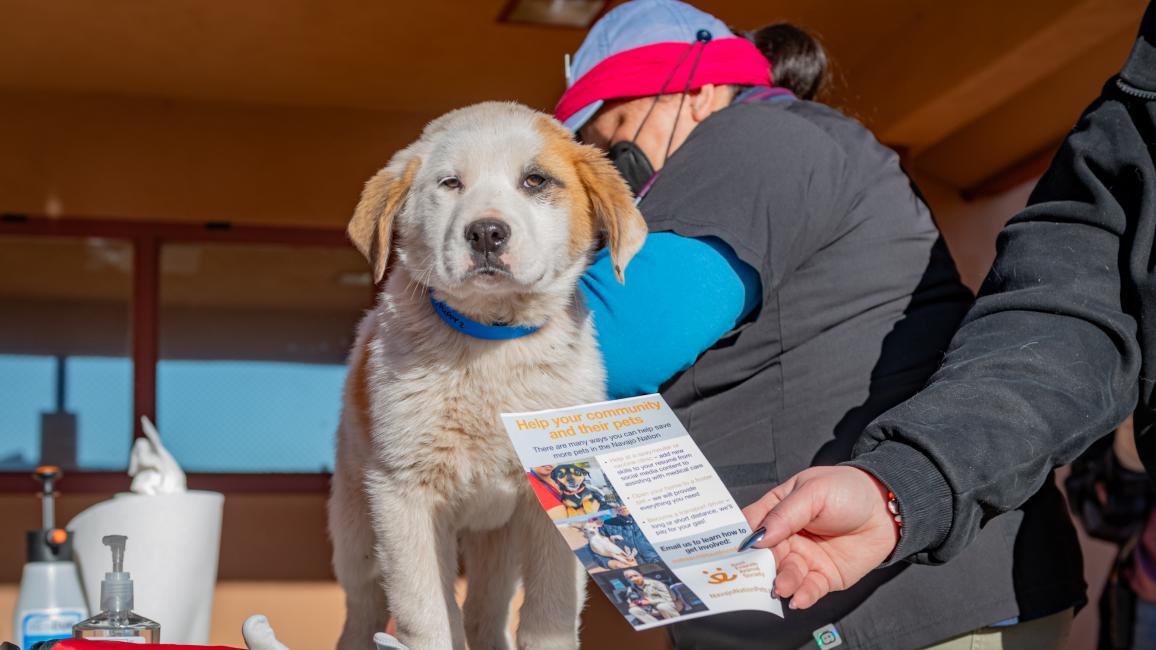
This past year, we hosted monthly, two-day clinics, primarily in two chapters, or communities, on the Navajo Nation: Tuba City and Kayenta (both located in the Western Agency, or region). We also hosted a three-day clinic in August with our shelter medicine team in Moenkopi Village on the Hopi Nation. At each of these clinics, we included drive-through vaccine administration and treatment for sick and injured pets. Want to see where we’ll be next? Check out this amazing resource for all veterinary care needs on the Navajo Nation.

From October 2024 to September 2025 at these mobile clinics, over a total of 25 days, we spayed or neutered 1,498 dogs and cats, provided vaccination services to an additional 1,866 pets, and treated 231 sick or injured pets.
These are significant numbers for the animal population. To put it in perspective, that’s hundreds of families bringing their pets to get the help they need, that’s dozens of volunteers putting their lives on hold for the sake of these animals, and that’s thousands of individual animals who weren’t treated like statistics –– but cared for as members of this community.
One of our staff members, Amy Gravel, joined a recent clinic and shared, “Getting to participate in the vaccine and spay/neuter clinic on the Navajo Nation was a highlight of my year. I felt so touched by the warm reception we received from all the locals, and you could really feel how much they cared for their pets. It was amazing to not only be able to give back but to spend time learning about a community outside my own.”
Comments like Amy’s are a great example of how no-kill is so much more than metrics. It’s about each individual animal and the people who love them.
Just before our monthly clinic in Kayenta in June of this year, we went door to door signing pets up for spay/neuter and vaccination services. Under the summer sun in the Southwest, these were long, hot days, knocking on every door and leaving no stone unturned. But that’s often what it takes. Reliable internet and cell service are limited in many parts of the Navajo Nation, so our outreach can’t rely solely on digital sign-ups or social media posts. Door knocking helps us spread the word and connect neighbor to neighbor with the people and pets who make up this community. It’s also how we build trust.
During one of those long days going door to door, the Best Friends team came across a home shared by multiple families and 18 dogs. These folks were responsive to our staff and eager to get all of their dogs spayed or neutered –– but there was a barrier. No one could transport all 18 dogs to the clinic.
And if there's one thing I love most about the incredible people I work with, it’s that they don't back down from a challenge. This was no exception. Best Friends staff and volunteers made multiple trips, ensuring all 18 dogs made it safely to the clinic and back. And when they learned that a nearby neighbor had five more dogs in need of the same services, they didn’t hesitate to help.

In the end, 23 dogs received spay/neuter surgeries, vaccines, and microchips — 23 dogs who might have otherwise gone without veterinary care. And when you multiply that kind of effort over months, over years, those numbers add up. That’s how community-based change happens: one conversation, one connection, one neighbor’s front door at a time.
I want to give a huge shout-out to all the Best Friends staff and our friends on the Navajo Nation who have continuously stepped up to make these lifesaving clinics happen, especially to our Navajo Nation staff: Cheena Rose, Keith Slim-Tolagai, Joni Lapahie, Lorraine Homer, Jennifer Johnson –– thank you.
And I want to thank all our volunteers around the country who put their lives on hold to save the animals in their communities. Without volunteers like Brenda and Marty Winnick funding and dedicating a Navajo Nation mobile clinic to the Sanctuary’s first veterinarian, Bill Christy, we would not be able to do the work we do.
Without you all, we would not be able to move this country forward toward no-kill. It takes a village. And I’m grateful that we get to call each other neighbor.
-Julie
Main Photo Credit: Vannessa Tom Photography