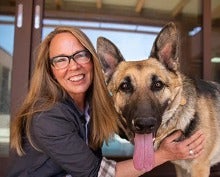
After 30 years, there's still no place like home
When someone recently pointed out that 2026 is my 30th year at Best Friends, I first took the comment as an unsolicited reminder of my age! However, after a momentary miff, that reaction was quickly followed with an appreciation of the fact that few people can say they have worked for the same organization and the same cause for 30 years and still find every day as amazing, challenging, and fulfilling as the first day I set foot in Best Friends Animal Sanctuary. For those of you who haven't heard about my chance encounter with my future, it started like this …
I was driving back from Mexico with two friends and just enough money for gas and a candy bar each. We were tired, grubby, sunburned, and ready to be done with the road, as was my old Dodge Colt that had three different colored doors and fenders from make-do bodywork. Law school at the University of Virginia was waiting for me in the fall, and my life felt mapped out. I knew what came next, and I wasn’t questioning it.
Then one of my friends asked if we could stop at an animal sanctuary in southern Utah; she was sponsoring a dog there. The other member of our crew and I huffed about it. We were ready to be home. But alas, we caved and diverted to meet her doggy friend.
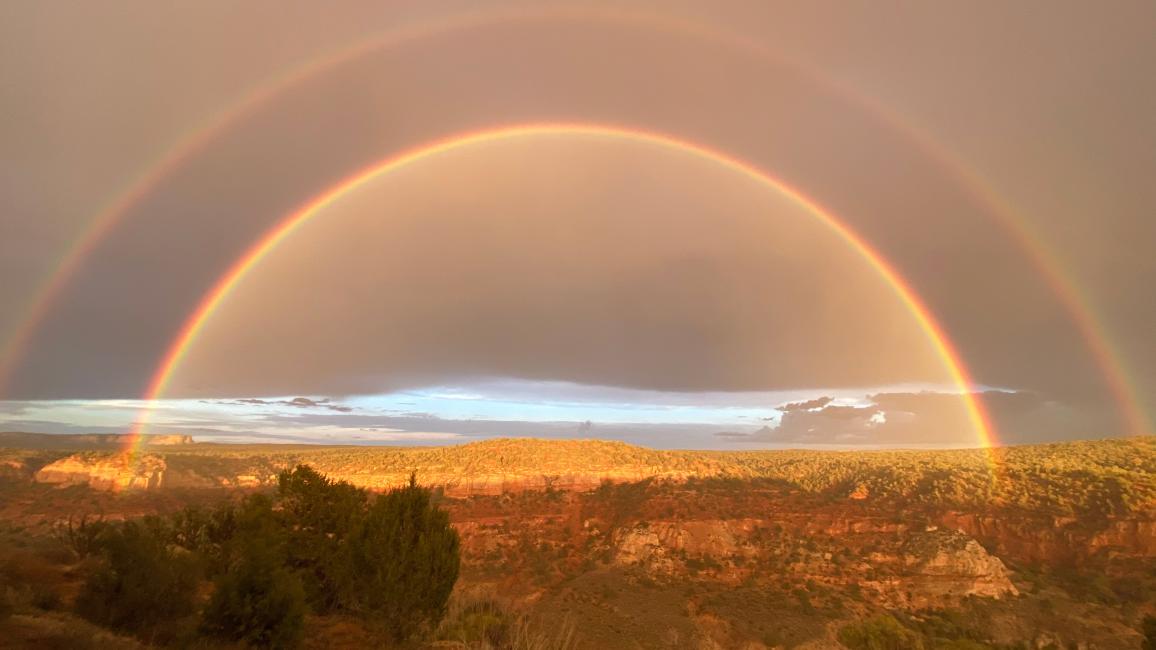
As we drove into a verdant red rock canyon, my irritation began to give way to wonder. When I stepped out of that old Colt, it felt like that moment in The Wizard of Oz when Dorothy steps out of the tornado-tossed farmhouse and everything moves from black and white to technicolor. The canyon opened up in front of us, red rock walls and endless sky. We met the animals — dogs leaning into you, cats weaving around your legs — and the co-founders who were changing the world. I was not in Kansas anymore, and my own tornado ride was soon to come.
When we drove away, I called my father, a very serious businessman and economist. Cue the tornado.
“Dad,” I said. “I’m not going to law school. I’m going to work at an animal sanctuary in the desert.” There was a pause, followed by some choice words. He wasn’t pleased, to say the least. But something in me was shouting at me, telling me that this is where I was meant to be.
So in 1996, I became employee number 17 at Best Friends.

I had no title, no long-range plan, and certainly no idea what the next three decades would hold. What I did have was a feeling that I had stumbled into something that mattered — and found the people I was meant to do it with.
I had joined a troupe of characters that was every bit as unlikely as the Tin Man, the Scarecrow, and the Cowardly Lion, backed up by the Lollipop Guild and Glinda. We set off down our own version of the Yellow Brick Road with all the confidence and enthusiasm of preschoolers at playtime. We didn't know what we didn't know, but the one thing we knew without a doubt was that killing homeless pets was wrong. What was lacking in resources was made up for in fearlessness, wild ideas, and enough moxie to challenge the formidable PTBs (Powers That Be).

Along the way, I saw things I never could have imagined. I didn't see flying monkeys, but I did arrange for two skydivers — one in a cat costume and the other dressed as a dog — to parachute onto the steps of the Utah Statehouse to kick off No More Homeless Pets in Utah. I saw my husband, Gregory, dress as an Elvis impersonator to promote the cause and my colleague and dearest friend, Holly Sizemore, suite up in a cat costume to spend the day inside a giant humane trap by the side of the highway to promote trap-neuter-vaccinate-return (TNVR). I even saw a cat win a Pulitzer Prize for Journalism, met and interviewed Dr. Jane Goodall for the Best Friends National Conference, and flipped the switch to light the Rockefeller Center Christmas tree.
All my crazy, out-of-the-box ideas were right at home at Best Friends because the founders were a rare gathering of slightly off-kilter and self-deprecating geniuses who had built a brand based on talking animals and a boatload of idealism. When they began hosting high-profile celebrity benefits in Los Angeles with the likes of Charlize Theron, Laura Dern, Bill Maher, Hilary Swank, and Noah Wyle (while still needing to collect donations at tables outside grocery stores to support the organization), they joked that it was like The Muppets Take Manhattan.

None of that, however, obscured the deadly seriousness of the task at hand. When I joined Best Friends, an estimated 17 million dogs and cats were being killed in shelters across America every year. There was only one no-kill shelter — the San Francisco SPCA under Rich Avanzino — and a virtual armada of old-school shelter directors and national animal welfare leaders launching torpedoes at the Owl and the Pussy-Cat's peapod of a sailboat that was the fledging no-kill movement.
But no-kill — the simple, commonsense understanding that the lives of the animals have intrinsic value and that the role of animal welfare is to save those lives and not to find more humane ways to take them — was wildly popular because the public was already there. The public, as Rich Avanzino had rightly observed, was the solution and not the problem as they had been made out to be for decades.

In time, more and more people jumped onto our Yellow Brick Road, including funders like PeopleSoft and Workday's Dave Duffield, corporations that want to give back and boost lifesaving like Walmart, and millions of regular folks who simply love their pets and don't want their children to grow up in a world where dogs and cats, just like the ones they cherish at home, are killed by the millions for the simple lack of a home.
Thirty years ago, there was one no-kill shelter in the United States. Today, 67% of the almost 4,000 American shelters are no-kill, and the number of animals being killed has dropped from 17 million to around 425,000 — still far too many but progress that seemed inconceivable when I first set foot on this road. And, today, rather than having an armada of entrenched interests lined up against us, the tables have turned. Today, Best Friends is at the center of a movement consisting of over 6,000 partner organizations serving and representing hundreds of millions of people.

Those are just a few snapshots over the past 30 years of my adventure that is Best Friends. I am humbled, honored, proud, and amazed to have been chosen to lead this extraordinary organization.
Sometimes I think back to that road trip and how close I came to skipping that stop. How easy it would have been to stay on the path I had already chosen. If I could call my dad today, I’d tell him that the world I stepped into all those years ago still feels just as technicolor as it did that very first day. I’d tell him that the adventure continues. And I’d quote Dorothy and tell him, "There's no place like home." Especially for homeless pets.
-Julie