Listening between the lines with horses
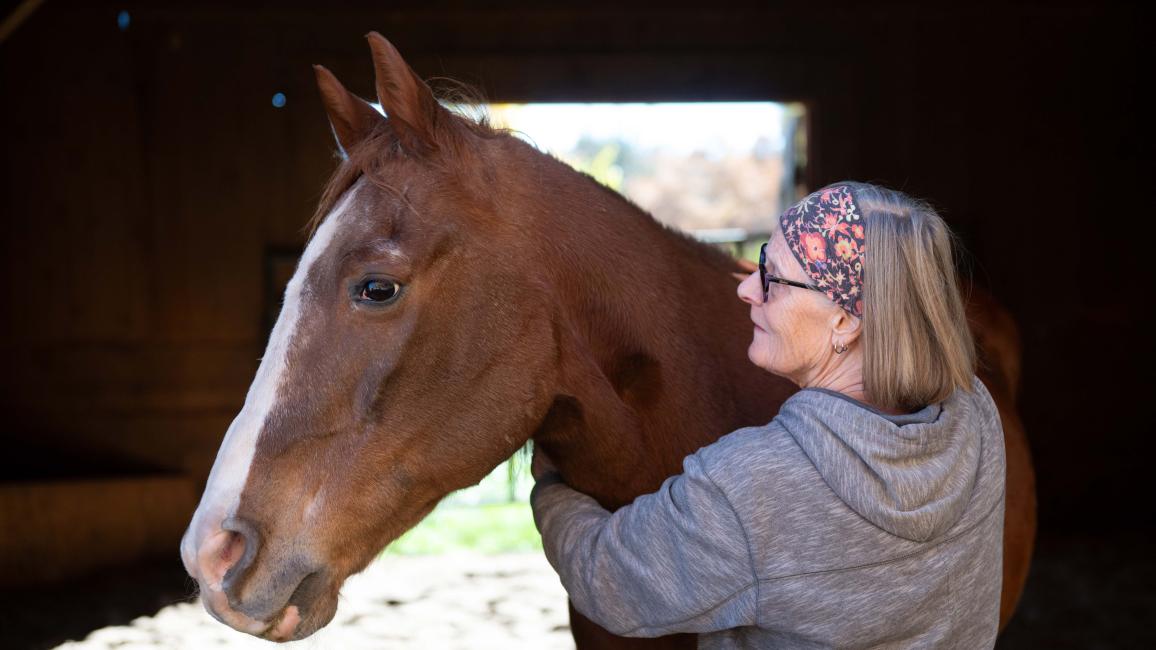
A gentle stroke that brings more comfort than the eye can see. A quiet moment between two beings, speaking a language that needs no words and conveys a connection that heals something inside. That’s what volunteer Karin Hamilton shares with the horses at Best Friends Animal Sanctuary.
Mucking paddocks before horse massages
Horse Haven at the Sanctuary is the home-between-homes for horses and other barnyard pals. They find refuge in its scenic pastures with people who understand and care deeply about their welfare.
Karin built relationships with several of the horses at the Sanctuary long before she ever began offering equine massages. She started volunteering by spending several mornings each week mucking paddocks and helping Horse Haven staff with daily care. Soon she graduated to walking horses around the peaceful paths that wind through the red rocks of the Sanctuary grounds, getting to know their personalities along the way.
Sometimes she’d return from a walk with one horse only to notice their pasture mate watching from the fence line, ears forward as if waiting for their turn for a gentle stroll through the trails.

More trust, less tension
Those quiet moments sparked a deeper curiosity in Karin. Eager to continue learning about horses and how to support their comfort, she took a course on the Masterson Method — a unique and interactive form of bodywork and massage for horses that focuses on gentle tension relief and trust building.
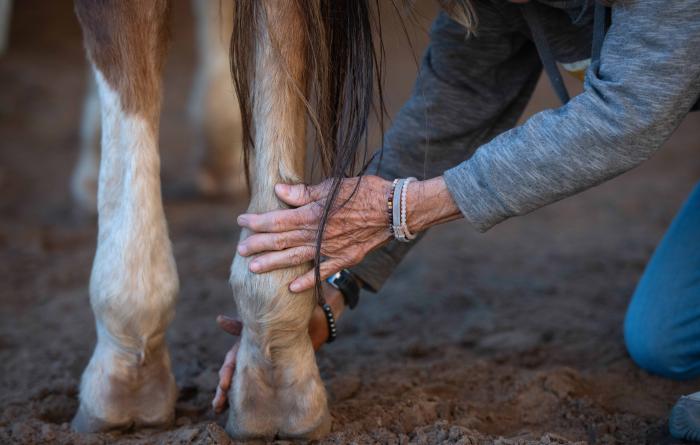
With the blessing of caregivers at Horse Haven, who knew just how much of an impact Karin’s love of both learning and the horses could have, Karin dove into finding ways to apply what she learned in the course through her volunteer work. Now Karin applies the Masterson Method to help the horses in Horse Haven, many of whom are older and living with arthritis. She works gently on the horses’ joints to ease tension.
“I’m older; they’re older. They have arthritis, and I know what that’s like,” Karin says.
Her growing interest led her to pursue more advanced training through the Northwest School of Animal Massage, where she focused on rehabilitation courses so she could bring that knowledge back to the Sanctuary.
Speaking a silent language
Her relationships with the horses rely on trust and communication — something Karin says happens largely without words.
“I feel as though the horses have invited me into this line of work,” she says. “It’s a wonderful connection with them. I’m able to get their muscles to be a little calmer or their connective tissue to be a little less squished. It feels like I’m listening to their silent language and to what their bodies are saying. I’m learning how to listen more every day.”
Each session with a horse is an invitation, never a demand. Some days, Karin says, a horse may step away or decline a certain touch, and that’s perfectly OK. The work always happens on their terms. If a horse chooses to come back and initiate contact again, Karin respects their boundaries and follows their lead.
That patience is part of what makes the work so powerful. Sometimes the lightest and slowest strokes can have the biggest effect.

Healing through stillness
“Horses are very sensitive,” Karin says. “And you have to work on yourself too. They’ll see if you bring in tension, so I work on being fully present with them.”
When the moment is right, a horse may soften, lower their head, or relax into the touch — small signals that tell Karin she’s listening in the right way.
Karin offers massages to local horses as well, but the work she does at the Sanctuary holds a special meaning for her, especially because some of the horses come from difficult pasts.
“How lucky am I to offer this to the horses at Best Friends?” Karin says. “It’s an amazing feeling.”
At Horse Haven, healing doesn’t always look dramatic. Sometimes it’s found in stillness, respect, and the quiet power of simply showing up.
Let's make every shelter and every community no-kill
Our goal at Best Friends is to support all animal shelters in the U.S. in reaching no-kill. No-kill means saving every dog and cat in a shelter who can be saved, accounting for community safety and good quality of life for pets.
Shelter staff can’t do it alone. Saving animals in shelters is everyone’s responsibility, and it takes support and participation from the community. No-kill is possible when we work together thoughtfully, honestly, and collaboratively.
You can help save homeless pets
You can help end the killing in shelters and save the lives of homeless pets when you foster, adopt, and advocate for the dogs and cats who need it most.


Saving lives around the country
Together, we're creating compassionate no-kill communities nationwide for pets and the people who care for them.

Get inspiring animal rescue stories delivered straight to your inbox
Never miss a feel-good animal story. When you give us your email, we’ll send you inspiring animal rescue stories each week, along with tips on different ways you can help save homeless pets in your community and beyond.