Getting an owl covered in concrete back to the skies

Time was of the essence to save a great horned owl who had somehow gotten into a cement mixer. The owl was found in St. George, Utah, with his face, chest, and right wing encased in dried concrete. He came to Wild Friends, the state and federally licensed wildlife rehabilitation area of Best Friends Animal Sanctuary. And the team quickly formulated a plan to get him in the air again.

When concrete meets feathers
According to Wild Friends supervisor Bart Richwalski, this was the first time in the department’s 40-year history that they had seen something like this. “He’s a youngster, which may be why he ended up in a concrete mixer,” says Bart.
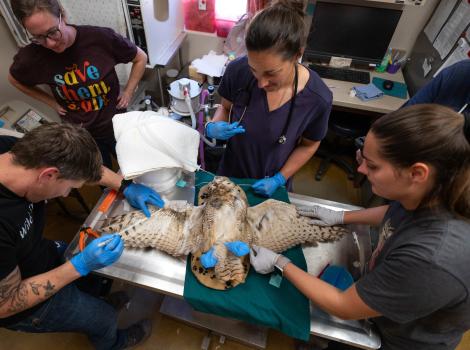
Bart reached out to other wildlife rehabbers, but no one he spoke with had ever experienced something like this. “After doing some research, our team quickly came up with a plan to help the owl in the least invasive way possible,” Bart says. Under anesthesia, the team would give the owl a 20-minute bath every day until the job was done.
[An owl's rare return to Best Friends Animal Sanctuary]
The team at Wild Friends worked tirelessly, using forceps, toothbrushes, and their fingers along with dish soap to clean his feathers and crack apart the concrete. Two weeks later, the owl began flying again, so they moved him to an outdoor enclosure to continue to heal.

The journey to silence
“Great horned owls typically have a downy coating on their feathers that allows them to fly silently as they hunt. But the concrete frayed the rescued owl’s feathers,” says Best Friends Chief Sanctuary Officer Judah Battista. Because the concrete affected the owl’s feathers, he makes a “whooshing” sound when he flies. That means he’d have trouble getting enough food in the wild if he were released now.
[Baby barn owls survive accidental road trip]
So the owl will stay in Best Friends’ care until spring or summer — after he’s molted his current feathers, grown in healthy new feathers, and can once again fly silently. “Once our owl friend recovers, we anticipate taking him back to near where he was found, not on the construction site but somewhere that is a natural habitat for him, and release him and let him be,” Bart says.
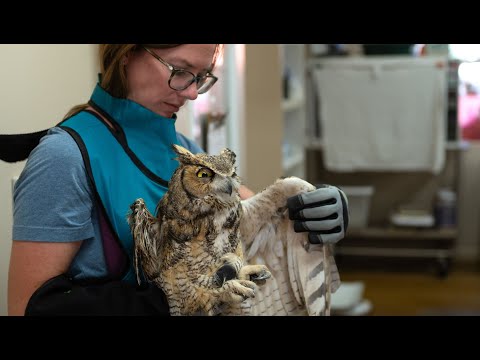
The owl who refuses to give up
The owl has faced this challenge with steady resilience. “He still has a long road ahead of him, but he’s a fighter,” Bart says.
For now, the owl continues his recovery under the watchful care of the Wild Friends team until the day he can soar silently through the trees again. His journey from a concrete mixer to a safe perch is a testament to resilience — and to the people who believe that every life is worth saving.

Let's make every shelter and every community no-kill
Our goal at Best Friends is to support all animal shelters in the U.S. in reaching no-kill. No-kill means saving every dog and cat in a shelter who can be saved, accounting for community safety and good quality of life for pets.
Shelter staff can’t do it alone. Saving animals in shelters is everyone’s responsibility, and it takes support and participation from the community. No-kill is possible when we work together thoughtfully, honestly, and collaboratively.

You can help save homeless pets
You can help end the killing in shelters and save the lives of homeless pets when you foster, adopt, and advocate for the dogs and cats who need it most.


Saving lives around the country
Together, we're creating compassionate no-kill communities nationwide for pets and the people who care for them.
Let’s be friends!
Connect with us on social media to stay in the loop about the lifesaving progress we’re making together.


