When a tiny puppy needs big help

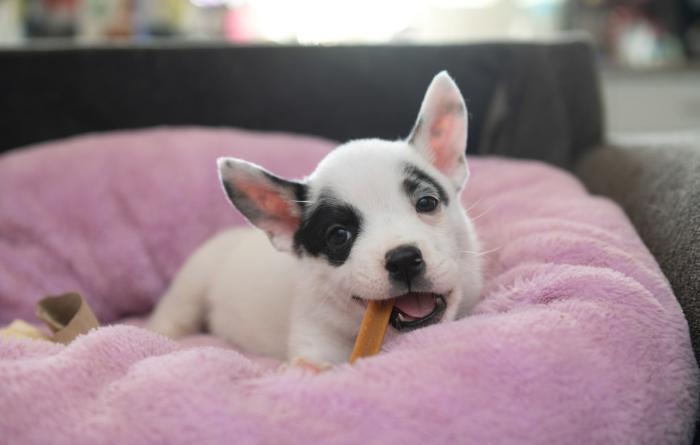
If you met Potato now — bouncing around, gnawing on toys, and begging for attention — you’d never guess how sick he once was. Before he became the happy, mischievous puppy he is today, Potato was a tiny, 4-week-old puppy with a serious illness.
He came to Best Friends Animal Sanctuary with his mom and littermates from a shelter. Best Friends supports shelters in reaching no-kill by taking in pets who may need extra care before going to homes. Though it would be bumpy, Potato was on the road to recovery.

Tiny puppy, big trouble
At the Sanctuary clinic, the veterinary team discovered that Potato had canine parvovirus — a highly contagious virus that affects the gastrointestinal tract of dogs and can be fatal if untreated. It can be especially serious in young puppies, so the team started treatment right away. Because they’d already been exposed to each other, the whole litter was set up in a comfy quarantined space at the clinic.
[Puppy sisters shine after beating parvo, distemper]
“There’s a new antibiotic we can give them,” says Maddison Collings, who works at the clinic. In addition, the puppies received other treatments to help their bodies fight the virus, including a fiber supplement, supplemental fluids, appetite stimulants, and syringe-feeding.
Potato’s siblings recovered and were soon adopted. Their mom went to the Best Friends Pet Adoption Center in Salt Lake City, where she was adopted.
As for Potato, his case of parvo was serious, and he received the whole gamut of treatment. But after about a week, he started to bounce back.
“Potato started chewing on his IV line and on his siblings,” Maddison laughs. That renewed spunk was a good sign.

A whole new world for Potato
Even though he was improving, due to how severe his case was Maddison brought Potato home as a foster pet.
“I wanted to give Potato an environment where he could be watched extensively to see if any other issues manifested — and to give him a well-rounded environment,” Maddison says.
[Quick response, teamwork save dogs in parvo outbreak]
In her home, Potato would get to meet her dogs, rabbits, and cats, “which really opened up his world after he was in quarantine for several weeks,” she explains. After two weeks without symptoms, dogs who have been treated for parvo can be around other animals. Maddison first introduced Potato to her oldest dog, Buddha, who brought the pup under his wing.
“Potato would get up and toodle around, eat, and then go back to sleep. Buddha would just keep an eye on him and watch over him for the first couple weeks,” Maddison says.

4 big teachers, 1 tiny student
As Potato grew, each of Maddison’s four dogs helped him learn how to interact with the world. They taught him where the food was, how to get on the couch, and what toys were. A sweet friendship built between Potato and Maddison’s 100-pound Rottweiler.
Behind the scenes, the veterinary team worked to ensure Potato received everything he needed to heal. Canine parvovirus can leave lasting effects on the gastrointestinal tract, and because Potato had a severe case of the virus, the team continued to watch out for any issues.
That wouldn’t stop him from wreaking havoc with his new friends. “He’s well-adjusted and a crazy little ball of energy now,” Maddison says.
That little ball of energy is now home for good after Maddison officially adopted him. Seeing him now — gleefully pestering the big dogs, racing around the house, and chewing anything he can fit in his mouth — it’s hard to believe he’s the same fragile pup who once fought for each hour. That happy chaos is a testament to what a second chance can do for a pet in need.

Let's make every shelter and every community no-kill
Our goal at Best Friends is to support all animal shelters in the U.S. in reaching no-kill. No-kill means saving every dog and cat in a shelter who can be saved, accounting for community safety and good quality of life for pets.
Shelter staff can’t do it alone. Saving animals in shelters is everyone’s responsibility, and it takes support and participation from the community. No-kill is possible when we work together thoughtfully, honestly, and collaboratively.
You can help save homeless pets
You can help end the killing in shelters and save the lives of homeless pets when you foster, adopt, and advocate for the dogs and cats who need it most.


Saving lives around the country
Together, we're creating compassionate no-kill communities nationwide for pets and the people who care for them.
Get inspiring animal rescue stories delivered straight to your inbox
Never miss a feel-good animal story. When you give us your email, we’ll send you inspiring animal rescue stories each week, along with tips on different ways you can help save homeless pets in your community and beyond.