Puppies are still America’s most reliable bipartisan issue
There are not many issues that get senators on both sides of the aisle in the same room, grinning from ear to ear.
Puppies are one.
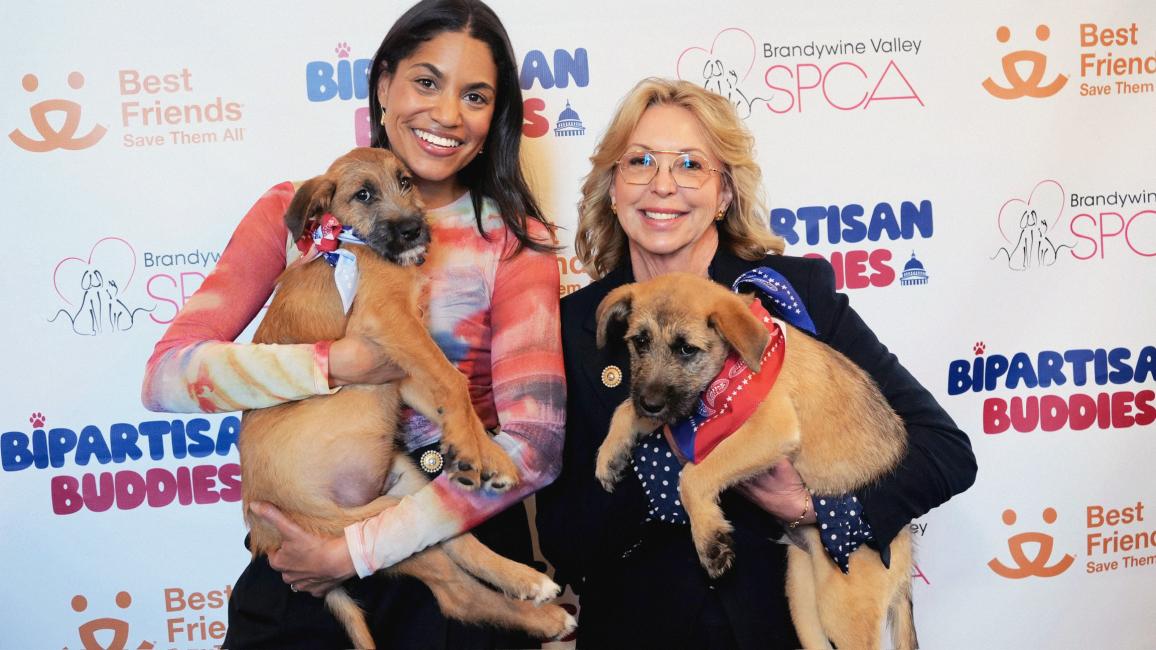
Earlier this month, the Bipartisan Buddies event brought Sens. Alan Armstrong (R-OK), John Boozman (R-AR), Cory Booker (D-NJ), Tina Smith (D-MN), and Mark Warner (D-VA) together for an afternoon on Capitol Hill with adoptable dogs from Brandywine Valley SPCA. The event was co-hosted by Alexis Booker (Sen. Booker’s wife) and Shelly Armstrong (Sen. Armstrong’s wife), alongside Best Friends Animal Society, and the conversation centered on something that doesn't get nearly enough attention for how much it matters: fostering animals.
When shelters have a foster program, adoption rates run an average of 30% higher than those without — because fostering does something simple and profound at the same time. You open your home, give a pet time and stability while they wait for adoption, and create space for another animal who needs it. It is one of the most powerful things an ordinary person can do.

And Capitol Hill is not the only place animal welfare has brought people together this spring.
In March, Utah Governor Spencer Cox signed Senate Bill 201 into law — requiring shelters to pursue all reasonable alternatives before euthanizing a dog or cat and establishing consistent protocols for shelters and rescue groups across the state. It passed with broad bipartisan support and arrived at an extraordinary moment for Utah. Fifty-seven of the state's 59 animal shelters are currently no-kill. The state is on the verge of joining Idaho and Montana as the third no-kill state in the West, and SB 201 is the legislation that can close that gap. It doesn't just set an aspiration; it creates a legal framework that holds shelters accountable to every reasonable option before a life is lost.
If just one in every 1,000 Utahns looking for a new pet chose to adopt rather than purchase, the state would end the killing of dogs and cats in its shelters entirely. We are that close. Legislators from different parties, different parts of the state, different ways of seeing the world looked at that reality and voted the same way.
That's the throughline I keep coming back to. Since 2016, the number of animals killed in U.S. shelters has dropped from more than 1 million to 400,000 — a 60% decrease. More than 2 out of every 3 shelters in this country are now no-kill, with hundreds more within reach.

That progress didn't come from any single policy or any single organization. It came from an enormous number of people deciding, in their own way and in their own communities, that it mattered — and then doing something about it. A foster family said yes. A shelter director tried something new and told her peers what worked. A legislature looked at the data and said yes too.
This month helped show us all how powerful the unconditional love of a pet can be for uniting even the most partial among us. Red and blue states alike have achieved no-kill statewide — Delaware, Idaho, Montana, New Hampshire, Rhode Island, and Vermont being the country’s six current no-kill states — with many more, like a kaleidoscope of red and blue, close to it. At the end of the day, the love we have for animals — and the drive we have for saving the ones in shelters — transcends politics, cultures, and backgrounds. No one can turn down a puppy snuggle.
If Bipartisan Buddies reminded me of anything, it’s that we’re not so different, you and I. Let’s all keep coming together and stepping up for our best friends. When we do, we all win.
-Julie