Teaching a spirited sheep to eat

Josie doesn’t know she’s any different from the other sheep in her foster family’s pasture. She’s just out there doing sheep things — like kicking up her heels for a good frolic and trotting after Claude and Eleanor, two Great Pyrenees dogs she’s pretty sure are her parents.
But Josie’s journey hasn’t been as simple as it seems. She was born with wry mouth, a condition that causes her jaw to misalign, so eating hay — the staple of a sheep’s diet — was a challenge. When she arrived at Best Friends Animal Sanctuary at 9 months old, her prognosis was uncertain. Grazing didn’t come naturally, and chewing was tricky at best.
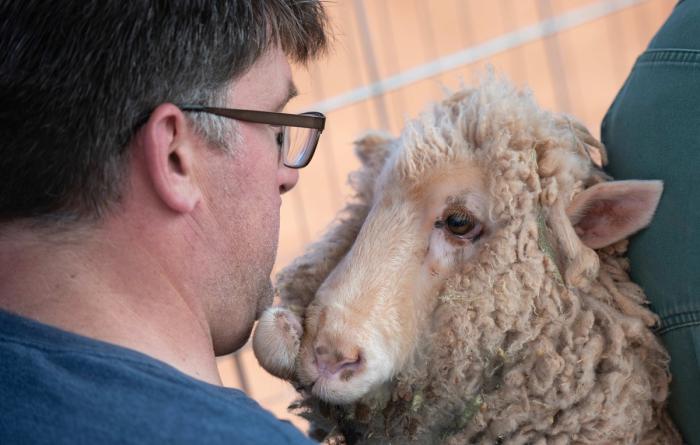
A goofy little gal
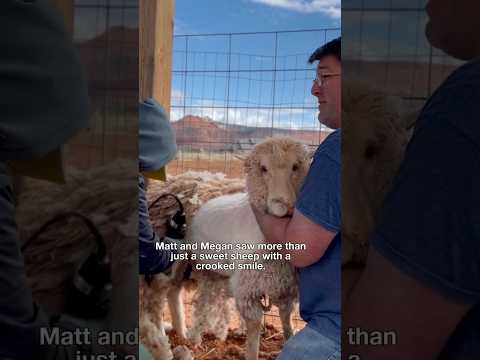
Thankfully, Josie had two foster caregivers who refused to give up on her. Matt and Megan Claflin saw more than just a sweet sheep with a crooked smile — they saw possibility. And they got to work.
“Every animal is an individual,” Matt says. “What works for one won’t necessarily work for another. So with Josie, it was all about observation — figuring out who she is and what she needs to succeed.”
[Orphaned lamb is beloved black sheep of the family]
That meant spending a lot of time with her — starting with hand-feeding her smoothies of sheep feed three times a day. “You get a lot of observation time when you’re feeding a sheep by hand,” Matt laughs. “Luckily, she’s got a great personality. She’s happy, curious, and quirky.”
Josie’s adorable quirks include bobbing her head to her own little tune as she walks, sneaking up on other sheep as they eat (only to scamper off when they notice her), and frolicking with Claude and Eleanor. “She likes to chase the dogs,” says Matt with a laugh. “She thinks it’s a fun game and bucks around while she’s doing it. Eleanor especially enjoys it.”

A table for one, please
To help her transition from bottle baby to independent eater, Matt built Josie a custom dining table. At first, it was raised high to meet her where her head naturally rested. “I started by setting the food container on the table, so she’d associate it with eating — even if I was still hand-feeding her,” he explains. “Then I began putting a little food in a bowl, just so she could nose around in it. Eventually, another sheep would come eat from it, and she’d get curious.”
Matt designed different versions of the table — some with deep bowls so Josie could use her jaw like a shovel, others with inserts to hold food in place. He also gradually shortened the table legs, encouraging her head into a more natural grazing position.
“The goal was to transition her slowly, building those muscles and instincts over time,” he says. “She’s still learning, but we’ve seen her start rooting around on the ground and even picking things up — not food yet, but she’s getting closer. That’s huge progress.”
And the transformation hasn’t just been behavioral. After her first shearing, Matt and the Best Friends veterinary team noticed that her wool, which had previously grown in uneven clumps, was coming in soft and even. “It confirmed what we’d suspected — that she hadn’t been getting the right nutrition before,” says Matt. “Now that she’s on a proper diet, her wool’s growing in exactly how it should.”
The world’s fluffiest shadow
These days, with all that help from her foster flock, Josie gives grazing her very best shot — and spends the rest of her time soaking up sunshine, chasing dogs, and just being her delightful self.
[Watch baby goats kid around at Best Friends]
Her story is a reminder that sometimes the best solutions don’t always come from a textbook. They come from listening, adapting, and caring deeply enough to try something different. And sometimes, they come with a wagging tail and a woolly little shadow following close behind.

This article was originally published in the July/August 2025 issue of Best Friends magazine. Want more good news? Become a member and get stories like this six times a year.
Let's make every shelter and every community no-kill
Our goal at Best Friends is to support all animal shelters in the U.S. in reaching no-kill. No-kill means saving every dog and cat in a shelter who can be saved, accounting for community safety and good quality of life for pets.
Shelter staff can’t do it alone. Saving animals in shelters is everyone’s responsibility, and it takes support and participation from the community. No-kill is possible when we work together thoughtfully, honestly, and collaboratively.
You can help save homeless pets
You can help end the killing in shelters and save the lives of homeless pets when you foster, adopt, and advocate for the dogs and cats who need it most.


Saving lives around the country
Together, we're creating compassionate no-kill communities nationwide for pets and the people who care for them.

Let’s be friends!
Connect with us on social media to stay in the loop about the lifesaving progress we’re making together.


