Supporting pets on the Navajo Nation
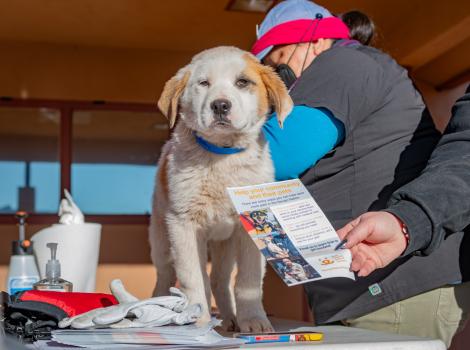
The line of vehicles snakes from the edge of a two-lane road, past the gas pumps in front, wrapping behind the convenience store and ending at a pop-up tent. There’s the woman in a red car with two kittens, tucked away in carriers, who are due for their first vaccines and deworming. There’s the family in a shiny blue truck with a handsome black shepherd dog in the back. In the church gym across the parking lot, a spay/neuter clinic is in full swing, with dogs’ surgeries and recovery inside, while cats are ushered into the mobile veterinary clinic parked there. People in bright vests help clients and four-legged patients, hand out vaccine paperwork and rabies tags, and set up appointments for future visits. It’s as bustling as any permanent veterinary clinic on a busy day, but by tomorrow the beehive of activity will be gone — until next time.
This particular beehive of activity isn’t far from Best Friends Animal Sanctuary in southern Utah, meaning it’s only about a four-hour drive. On the Navajo Nation, distance is measured not in miles, but in hundreds of miles, and travel time in hours, rather than minutes. Getting to the Navajo Nation requires crossing the invisible boundary of the 27,000-square-mile reservation. If you are not from there, you enter as a guest in a sovereign nation — a staggeringly beautiful landscape of red rocks, slot canyons, monuments, and mountains — the ancestral home of the people and animals who live on the reservation today.
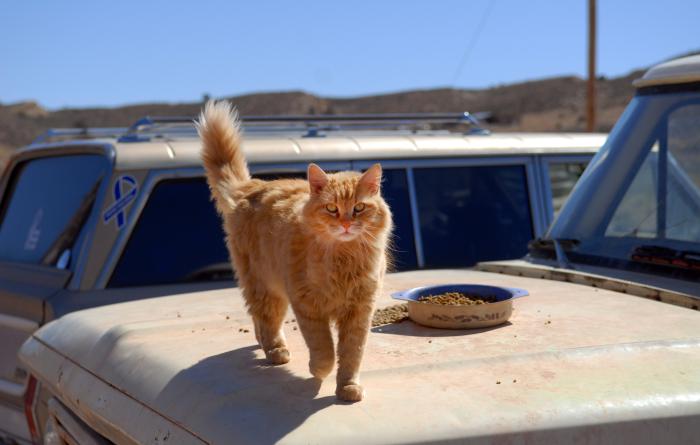
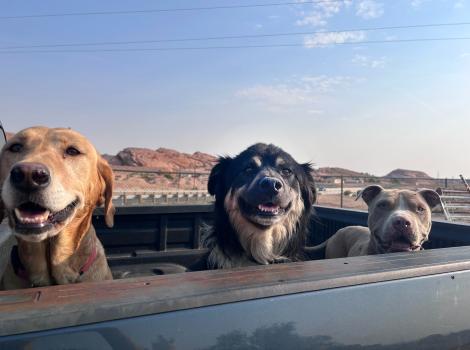
You will almost always see dogs. Dogs trotting along the road. Dogs napping near gas pumps outside a convenience store. Dogs in the backs of trucks and on people’s front steps. Dogs are part of life for the people who call the area their home. When those dogs are spayed or neutered, vaccinated, and well-fed, life is good. When they’re not, it leads to serious problems for dogs, for people in the community, and for livestock.
People on the Navajo Nation love their pets and will go to great lengths to get them the care they need. But the remote location, its federal designation, and the restrictions that come with it all add up to special challenges for people to access basic services for their animals. Working through those challenges together is what this story is about.

Taking care of animals
Joni Lapahie has been taking care of the animals on her farm, including dogs and cats, for her entire life. “My dad is a big dog lover, and that influenced me a lot,” Joni says. “He was always bringing home strays, and we were always taught to respect animals, because it’s life.”
A few years ago, she heard about a pop-up pet vaccination clinic and decided to bring her dogs in. That day ended up changing the course of her life.
The people putting on the clinic were struggling to keep up with the number of pets arriving, and someone working there mentioned that they didn’t have any volunteers. Joni says, “I thought, well, we can help.”
Not only did Joni get her dogs vaccinated that day, she and her four kids started helping at pet spay/neuter and vaccination events on the Navajo Nation. The organization she volunteered with is one of a handful of dedicated groups doing veterinary outreach work there, and they also spayed or neutered all Joni’s dogs for her.
Before then, Joni was among the many folks who didn’t know about the veterinary services that people from outside the reservation were bringing in for animals. It was an entirely new experience and a different aspect of taking care of dogs, which she’d been doing her whole life. “Growing up,” she says, “I didn’t even know you could get dogs fixed. I didn’t know dogs needed shots.” Caring for animals turned out to be a calling for Joni (more on that later).

A long history
To begin to understand how things are on the Navajo Nation for pets, you need to be aware of the history. Each person, each family is unique, but as a people, the Navajo have a shared, not-so-distant history that impacts nearly every aspect of their lives today. For example, Joni lives on a farm an hour away from the nearest town. She has cows, sheep, horses, chickens, and rabbits. And when she says she lives on a farm, she’s referring to 15,000 acres that she and her relatives have lived on for generations.
“The area was settled by my great-great-great-grandmother after they came back from the Long Walk,” Joni says.
The Long Walk happened in 1864 when the U.S. government forced over 8,000 Navajo, or Diné, people off their land, making them walk 300 miles to a prison camp. Four years later, survivors were allowed to return to a designated reservation on part of their homeland. That history is visible today in efforts to preserve the Diné language, traditions, way of life, and culture.
[Our Navajo neighbors: The clinics and the pets who bring us together]
Joni and her family still maintain some of the original homesteads from the 1800s. In the 1940s, uranium, coal, and oil extraction left behind abandoned mines and wells and an epidemic of poisoned water, cancer, and other diseases. The median household income is about $30,000, with many families earning much less because of the high rate of unemployment (around 50%).
With history and current challenges like these, it’s understandable that people on the Navajo Nation might think twice about anything offered to them from outsiders. Through volunteering at the clinics, Joni realized, “This is something I would like to do.”
Today, Joni is a Best Friends Navajo Nation specialist, one of several staff who live and work on the Navajo Nation. She’s one of the people checking in patients for surgery and going out into communities to vaccinate people’s pets, as well as fostering dogs and cats from an animal shelter on the reservation and getting them ready to be driven to rescue groups in surrounding states, where they can be adopted into new homes.
All this work is part of what Best Friends is doing alongside the Navajo Nation government and other organizations that have been working there for years. Everyone involved wants to see the animals have healthy, happy lives with their families. But when dogs aren’t spayed or neutered, fed well, and looked after by someone, they can end up in a shelter system that’s small against the vastness of the reservation.

Navajo Nation animal shelters
The Navajo Nation’s four small animal shelters were built in the 1960s and haven’t yet evolved into the community resources that others around the country are becoming. Joe Begay Jr. has been with Navajo Nation Animal Control for more than 20 years and was recently appointed to the position of program manager.
He’s seen it all over the years, including the challenges regarding access to veterinary care. “Some people, including our elders, live in rural areas where there’s no electricity, even running water, and they don’t have access or transportation to take their pets in for veterinary care,” Begay says. “When they have multiple dogs and they have puppies, those numbers can add up really fast.
The area that Navajo Nation Animal Control covers is huge, and the team is so small that officers spend most of their time driving and responding to calls about dog bites or dogs going after livestock. Unneutered, hungry dogs who strike out on their own to find food are at risk of getting into trouble. “We’ve had some really severe cases,” Begay says, which are heartbreaking and scary for everyone.
[Navajo Nation residents go the extra mile for pets]
These situations are part of how an estimated 9,000 to 10,000 animals come through the reservation’s small shelters each year. The remote location and number of animals coming in mean that saving those pets’ lives is dependent on transferring them out to other organizations. “We try to get rescues to come and pick them up as soon as possible,” Begay says. “It’s most often a lot of puppies.”
Begay hopes for a day when the loose dogs they pick up to return home could be spayed or neutered before going home.
“It’s a tough situation here,” he says. “Every day, it’s the same thing: We get calls about dogs over here, dogs over there.” But hope and momentum grows as more residents become aware of the benefits of spaying or neutering their animals and outside organizations work together to make their services more accessible.
The best news is a plan for a brand-new, modern Navajo Nation animal shelter that will have a veterinary clinic. “It’s been a long time coming, so I’m looking forward to it,” Begay says. “Maybe after we build that shelter, it can be a model for the other four shelters.” Until then, he and the other animal control program staff are busy doing the best they can with the resources available and working with the people who are bringing in assistance.

Looking ahead
Michelle Weaver, Best Friends director of Sanctuary outreach, explains how Best Friends has increased its work with the Navajo Nation in recent years. “They’re our neighbors, and they have an animal control program,” she says. “Just like other communities we support, we asked, ‘Is there something we can do together? Are there changes you want to make?’”
Providing veterinary care and spay/neuter and finding placement for animals who end up in the shelters are the priorities, so that’s exactly what Best Friends is doing. “We’re mindful that some decisions aren’t ours to make,” Michelle says. “I don’t want to add to the harmful history of outsiders coming in and telling people what they should do or that what they’re doing is wrong. That’s not my place. I’m a guest there.”
Some things may move at a slower pace on the Navajo Nation, but, Michelle says, “A slower pace doesn’t mean worse. Our fast pace isn’t always healthy either.” And consistently working with the people, the government and other nonprofits is making a difference.
“Living here and seeing it every day, I can see a difference,” Joni says. During the pandemic, she would often stop at a water well not far from her home and would almost always find stray dogs there. Now, it’s rare to find a stray dog at the well. People will drive for hours and wait all day for their pets to be spayed or neutered at a pop-up clinic. Things are getting better — and there’s hope. “I can see it. I can just imagine what it’s going to be like in five years,” Joni says. “Who knows, we could be no-kill on the Navajo Nation. That’s what I envision.”
How Best Friends is helping
- Monthly veterinary clinics around the Navajo Nation see hundreds of pets for spay/neuter, microchipping, vaccinations, and treatment for illness or injuries.
- A formal agreement between Best Friends and Kayenta Township (a community on the reservation) is providing consistent veterinary care to pets there. The impact to date is even higher rates of people having their pets spayed or neutered, vaccinated, and treated for illnesses as needed.
- In 2025, Best Friends Animal Sanctuary took in 93 cats, 171 dogs, and a horse from the Navajo Nation for on-site veterinary care and placement in new homes.
- The Best Friends mobile veterinary clinic, made possible by a generous donation, has been fully operational since January 2024.
- Since the program started in early 2021, Best Friends has picked up more than 8,000 dogs and cats from Navajo Nation shelters and driven them to communities in multiple states to be placed in new homes by partner organizations.
This article was originally published in the March/April 2026 issue of Best Friends magazine. Want more good news? Become a member and get stories like this six times a year.
Let's make every shelter and every community no-kill
Our goal at Best Friends is to support all animal shelters in the U.S. in reaching no-kill. No-kill means saving every dog and cat in a shelter who can be saved, accounting for community safety and good quality of life for pets.
Shelter staff can’t do it alone. Saving animals in shelters is everyone’s responsibility, and it takes support and participation from the community. No-kill is possible when we work together thoughtfully, honestly, and collaboratively.
You can help save homeless pets
You can help end the killing in shelters and save the lives of homeless pets when you foster, adopt, and advocate for the dogs and cats who need it most.


Saving lives around the country
Together, we're creating compassionate no-kill communities nationwide for pets and the people who care for them.

Get inspiring animal rescue stories delivered straight to your inbox
Never miss a feel-good animal story. When you give us your email, we’ll send you inspiring animal rescue stories each week, along with tips on different ways you can help save homeless pets in your community and beyond.