Lawrence thinks you’re not giving animal shelters a shot — and maybe he’s right
I’ve known Lawrence for a long time. Lawrence Nicolas is the CEO of the Jacksonville Humane Society in Jacksonville, Florida. And if you’ve been working in animal welfare for even five minutes, there’s a good chance he’s already on your radar.
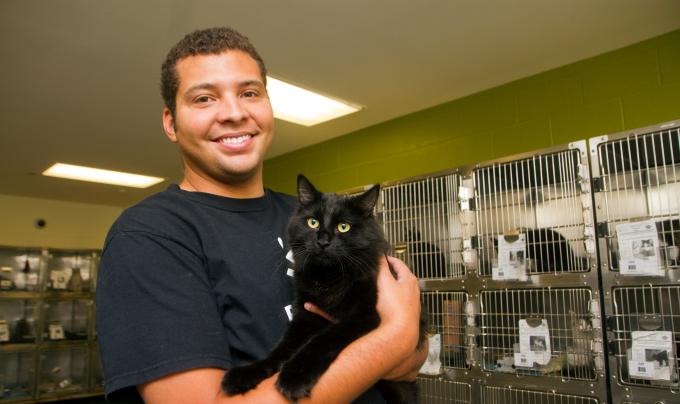
Lawrence is one of those leaders who’s always trying something new. One day he’s running the kitten nursery at the Best Friends Pet Adoption Center in Salt Lake City and posing for photos with an ear tip (see below) –– and the next he’s all dressed up in a suit and tie inspiring the next generation of leaders. We’ve talked a lot over the years about this movement, but I wanted to get his perspective on where we are today. And, as you’ll read in this conversation, Lawrence doesn’t disappoint.

Me (JC): We all have a moment we can point to that first pulled us into this work. What’s yours?
Lawrence (LN): I was always an animal lover, but I began working at the local shelter right after college for a simple reason: I needed a job. It was on the heels of the 2008 economic downturn and was a difficult time to enter the labor force. Once I got into the shelter and learned about the amazing work we were doing, I never looked back.
I had a foundational moment in 2012 that changed my career trajectory forever. The shelter I was working with at the time was not no-kill, and I admittedly didn’t know what that meant or what more we could be doing; it was the shelter I grew up working in and how I assumed sheltering was supposed to be done. I had a weekly shift in the euthanasia room, every Thursday morning, which was as difficult as it sounds. On one particular Thursday, I found I had over 60 cats on my euthanasia list, due to being housed in the same room as a cat who tested positive for ringworm. For the first time, I truly began asking myself: Is this the best we can do? Can we not save more of the animals coming into our shelter every day? Which at the time was a heck of a lot — over 100 animals could enter our shelter on a busy day. This was when I first began to learn more about no-kill.
JC: What advice would you give someone just stepping into this world?
LN: Find your “why” and remember it. And don’t lose sight of it, particularly on those days that are the most difficult. I have found over the years that one of the characteristics that sets people who make animal welfare a career apart from those who see it as a “job” is the ability to come back to that “why” on the days that are the hardest and remember the good they’re doing rather than allow the hardest days to define them.
JC: Tell us about an animal who has stayed with you after all these years. Who are they, and what’s their story?
LN: The first face that came to my mind is one from my time at Best Friends’ kitten nursery in Salt Lake City in 2015. There was a little gray kitten, cleverly named Grayson. The cards were stacked against Grayson from the beginning. He came in only a few days old, alone, and in bad shape. He fought to overcome his challenges and was eventually adopted. I will never forget Grayson because he is exactly the kind of kitten that would have never made it out of most shelters in the country at the time. If Best Friends’ nursery had not existed, he most certainly would not have survived. But the nursery was able to truly save his life, along with thousands more just like him.

JC: What do you wish more people knew about pets in shelters?
LN: This is something I think a lot about. I still talk to so many people who have the “pound” perspective on shelters: that they are cold, impersonal, sad, scary places. Places of concrete, plywood, and steel bars. Places where animals go to be forgotten. I want shelters to be seen as what they are: vibrant community centers, places full of joy, happiness, second chances, love. Places you want to bring your family, not places you avoid altogether. So often people associate shelter pets with being second-rate or substandard in some way, which is simply not true at all. A pet at a shelter is every bit as wonderful and special as a pet from anywhere else, and they deserve a second chance at love and happiness.
JC: Tell me about a risk you took that paid off.
LN: After working for Best Friends for about eight years and another sheltering organization for two, I moved to Jacksonville to be the successor to our soon-to-be-outgoing CEO Denise Deisler. Denise is nothing short of a living legend in animal welfare; her impact on our field and what she created here in Jacksonville is nothing short of remarkable. I knew it was a risk to come to JHS and follow her legacy –– they were big shoes to fill. However, Denise was an incredible mentor, and I owe so much to her and her leadership.
JC: Brag a little. What’s your organization’s proudest accomplishment of the past few years?
LN: 2025 was the highest intake year our organization has had in 20+ years, taking in almost 11,000 animals — mostly cats and kittens. Instead of continuing with the status quo and resigning ourselves to admitting more and more kittens every year, we have taken an extremely proactive, targeted approach to our TNVR work (trap, neuter, vaccinate, return) and are spaying and neutering community cats in all of our intake hot-spot areas throughout Jacksonville. Having a laser focus on spay and neuter has already had a huge impact on our community.
JC: Tell us about a moment where, together, people made something possible you couldn’t have done alone.
LN: The improved saving of dogs’ and cats’ lives across the state of Florida is one of the best examples of collaboration I can think of. Our statewide program, Florida Leaders in Lifesaving, played a huge role in jump-starting the collaboration and helping forge relationships throughout the state. Seeing shelters, rescue groups, clinics, community members, and others come together around that framework by working together has been remarkable, and I am so proud of how far Florida has come. We still have so much work to do, but Florida is a better place for shelter pets today than it was 10 years ago, and that’s worth celebrating. I think we have all of the ingredients we need to finally realize our goal of no pet dying in shelters unnecessarily.

JC: What’s the easiest thing our readers could do today to help save pets in their community?
LN: Be curious, ask, and really listen to the answer. Every community is facing different challenges, and those challenges can change significantly over time. Speak with people involved in animal welfare issues in your community and ask them how you can help.
JC: Now, let’s hear about the pets in your home.
LN: Right now we only have one dog, a 7-year-old Pekingese mix named Wicket. At our most, we had five cats and three dogs, but as they aged and our son was born, we did not adopt anyone else, and now we are down to one. But I see a new cat in our future very, very soon.
Always got something cooking, that Lawrence. But I keep coming back to what he said about remembering your why, especially on the hardest days. After all these years in this work, that’s advice worth hanging on to. We’ve come a long way, we have a lot of work still ahead of us, and the animals need us to keep going.
Lawrence is kicking off a series of conversations I’ll be having with leaders across this movement, and I’m already looking forward to the next one. I’ll see you back here in two weeks.
-Julie