Getting more out of giving back to the animals
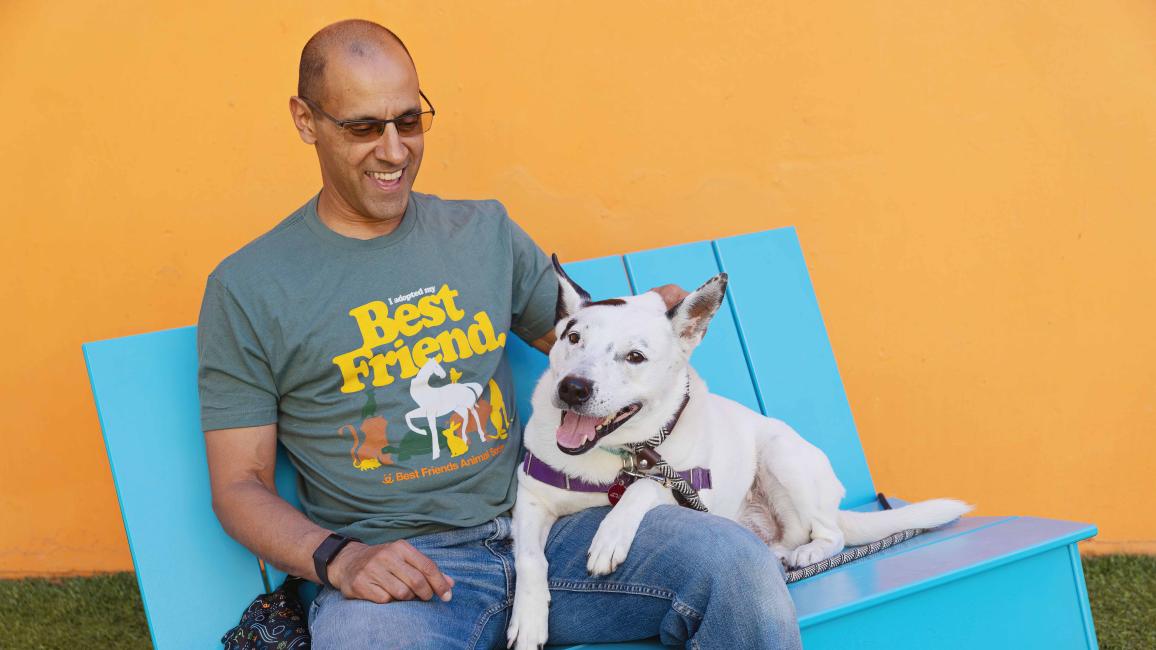
Robert Lobo loved his two cats. As someone reading this story, you likely understand that kind of love. The relationships we have with our pets can be among the most unique, most fulfilling, and most rewarding of our lives for reasons too numerous to list here. But we don’t have to — because you probably already understand all that. And so did Robert.

But, 11 years ago, while driving down the 405 freeway in the Los Angeles area, he saw a sign. Not a figurative one. An actual one. A billboard for Best Friends Animal Society. In that moment, Robert wondered whether the love he had for his own cats might be something he could share with other pets. The seed of volunteering for the animals had been planted and would blossom ultimately beyond anything he might have imagined on that drive.
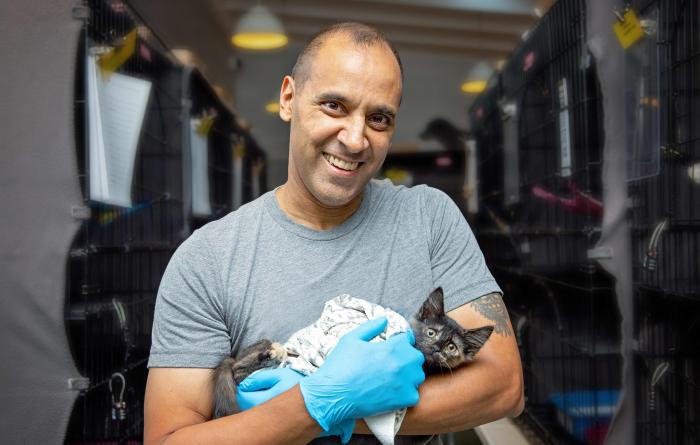
Since that day just over a decade ago, Robert has logged an astounding 5,000-plus volunteer hours for Best Friends — hours he finds above and beyond his demanding career as an executive. (This is not a man who has plenty of spare time, which makes his commitment all the more inspiring.)
Robert’s foray into volunteering with animals began with baby steps. When he first started to volunteer at the Best Friends Pet Adoption Center in L.A. in 2014 (then the NKLA Pet Adoption Center), he kept to himself. He popped in about once a month, playing with the dogs and taking them for walks. That’s what worked for him then. In fact, for the first couple of years, he was only able to volunteer a handful of times. For many busy people with full lives, that’s what they feel they can give. For others, it can feel intimidating to give more, and Robert wasn’t quite sure what else he could offer. But, as he puts it now, “Like a lot of things in life, the more you give, the more you’ll get out of an experience.”

The next step
Fate intervened when Robert had a fortuitous encounter as he was leaving his first volunteer shift of 2018. “I always work the first shift on New Year’s Day,” he says. Call it a case of New Year’s motivation, but Robert was feeling inspired — like he was on the precipice of change and deeper involvement.
“I was signing out at maybe 11 a.m.,” he says, “and I ran into our volunteer coordinator. I happened to see him at the perfect time, I guess, and I asked him if I could start hosting dog team training classes.” After walking dogs for years, he thought it would be the perfect next step. He had attended that class years before and had been applying what he’d learned ever since.
[The givers: Volunteering for the animals]
Teaching the class would mean becoming a mentor to other volunteers, and it just felt right. Robert recognized that volunteering means more than clocking in and out. It means belonging to a community — and he wanted to be a bigger part of it. “I shadowed our coordinator a few times and then started hosting those classes in February 2018,” he explains. In doing so, Robert got to know each member of the staff and every new volunteer — cementing his position as part of the team.
Of course, his increased involvement as a volunteer didn’t just change Robert’s life. It also changed life for the animals. Robert would go on to attain the highest level of training for handling dogs with behavior challenges, which meant that each of those dogs now had another qualified and caring person to interact with and to advocate for them.
An inspired idea
One of Robert’s favorite dogs, Harvey, had a long stay at the center before he was adopted. Harvey is a blocky-headed dog with a big heart, but he didn’t present well in his kennel. Robert says, “He would just stare at people and seemed very stiff.” But then a volunteer offered to pay Harvey’s adoption fee, and not long after, Harvey headed home with his new family.
Robert had worked closely with Harvey, and after the pup was adopted, he had an idea: He asked whether he could follow up with Harvey’s adopters. “I got to spend time with Harvey’s owners and really get to know them,” Robert says. “It inspired me to follow up with any adopter of a longer-stay or a more behaviorally challenged dog. Even if I haven’t met this person, I know and have walked the dog. And I’m local. So, if they need anything, I’m happy to come over and won’t charge anything.” Even if that support means simply confirming that the adopters are doing everything right, Robert takes time to connect with them, which helps to keep dogs like Harvey in loving homes.
It doesn’t end with the adopters. Robert makes sure that everyone who plays a role in the pet’s life gets to celebrate the win. “As soon as Harvey got adopted, I let all the volunteers who worked with him know and sent them the adoption pictures. It’s about spreading positivity,” he says.
“I’m not inventing anything new. If you look at what shelters are doing around the country and you think your shelter could do it too, just ask,” Robert advises. “Sometimes you have to push a little bit, but it could lead to new programs going forward.” Programs that give pets more time to shine and improve their adoption prospects help everyone feel they’re part of something greater. And even if the staff at your organization say no to your suggestion, or say they have limited resources to implement it, introducing an idea is always an important start.
[13 stories of volunteers who save pets’ lives]
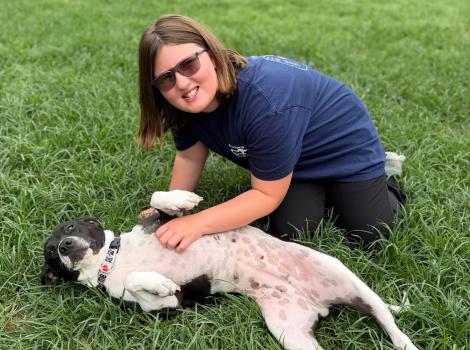
Robert continues to pay special attention to the dogs who need it most, and he approaches each dog he works with differently. “I am now working with Remi,” he says, “a 105-pound mastiff mix who came to us with cherry eye” (when the tear gland in the inner corner of the eye pops out of place). Two procedures later, she is recovering well, and Robert is helping Remi with her behavior issues. “It is difficult to muzzle-train her because the muzzle gets close to her eyes, but I have been working to keep her calm on walks,” he says. “I started massaging her paws as a reward after muzzle training, and she now requests paw massages on every walk.”
Like any endeavor that entails caring for a variety of unique beings of different backgrounds and personality types, there is no “one size fits all” approach. And the same can be said for volunteering — there’s no one way to be involved. What feels right for you might be different from what’s right for Robert or any of the thousands of incredible people who give their time to help the animals each year.
It is true, though, that no matter how much you are able to give, deepening your impact as a volunteer will connect you to a community and help save lives. So if you’ve been looking for a sign to do more in your corner of the country and you’re not in a position to spot a billboard on the 405, well, consider Robert’s story the sign you’ve been waiting for.

Robert’s suggestions for how to deepen your impact as a volunteer:
- Find ways to expand your involvement. Make a list of several ways you could contribute more — whether that’s taking on more shifts on your days off or just saying yes when someone asks for help.
- Introduce yourself to the staff and other volunteers. Something as simple as saying hi when you start your shift can improve your experience and fold you into the community. Don’t wait for permission — jump in.
- Don’t be afraid to suggest ideas. There are a lot of brilliant people working to save animals’ lives every day and no shortage of opportunities to get creative and save more lives. Follow local organizations and maybe even a few around the country. See if they’re running innovative programs that you could help your team replicate.
- Add a personal touch. Become a resource to adopters, especially those who encounter challenges with their new pet. Talking through possible solutions is incredibly helpful. And, of course, reinforce the good work that adopters are doing.
- Track your growth. Tracking why and how you achieved what you did as a volunteer will grow your experience. Even if you’re just going from volunteering once a year to once a month, noting your intentions will help you stay motivated.
This article was originally published in the March/April 2026 issue of Best Friends magazine. Want more good news? Become a member and get stories like this six times a year.
Let's make every shelter and every community no-kill
Our goal at Best Friends is to support all animal shelters in the U.S. in reaching no-kill. No-kill means saving every dog and cat in a shelter who can be saved, accounting for community safety and good quality of life for pets.
Shelter staff can’t do it alone. Saving animals in shelters is everyone’s responsibility, and it takes support and participation from the community. No-kill is possible when we work together thoughtfully, honestly, and collaboratively.
You can help save homeless pets
You can help end the killing in shelters and save the lives of homeless pets when you foster, adopt, and advocate for the dogs and cats who need it most.


Saving lives around the country
Together, we're creating compassionate no-kill communities nationwide for pets and the people who care for them.

Get inspiring animal rescue stories delivered straight to your inbox
Never miss a feel-good animal story. When you give us your email, we’ll send you inspiring animal rescue stories each week, along with tips on different ways you can help save homeless pets in your community and beyond.