Overheard at Best Friends National Conference 2026
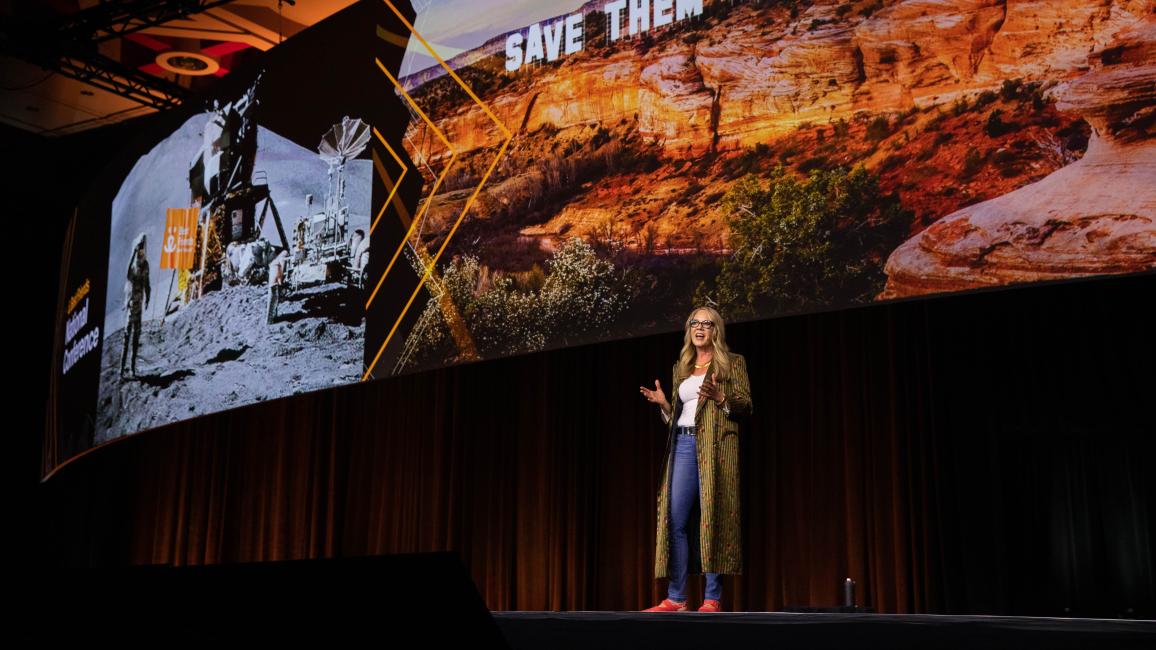
Last week, Salt Lake City, Utah, played host to Best Friends National Conference 2026 — and on my drive back to Kanab, I just kept thinking about how reinvigorating those three days were.
Three full days of learning, sharing expertise, asking questions, pushing for more. And the word I keep coming back to — the one that felt like it was quietly hanging in the air across every session, every hallway conversation, every exchange in the Hub — is possibility.
This year, more than 1,325 attendees from 49 states came together at the Calvin L. Rampton Salt Palace Convention Center. Of those attendees, 60% of them were first-timers — 60%! I see that as a signal that more people are coming to the table, that the movement is widening, and that something is drawing people in who hadn’t been drawn in before. I find that thrilling.
And none of it happens without the people working behind the scenes to hold it all together. This year, 198 volunteers showed up, working more than 475 shifts and contributing 1,873 hours to make this conference possible. Thank you to each and every person who volunteered. That kind of generosity is its own form of lifesaving, and we could not do this without you.

Over 75 sessions ran across three days in formats designed to meet people where they are. In sessions like Open Doors: Removing Barriers to Lifesaving, presenters Ed Jamison and TyAnn Sumpter — of Operation Kindness and SPCA of Brazoria County, respectively — didn’t shy away from the uncomfortable truth that sometimes our own well-intended policies are the thing standing between a pet and a home.
And then in My Opinion About the Term ‘No-Kill’ Doesn’t Matter (and Yours Probably Doesn’t Either), Brent Toellner opened up a genuinely hard, genuinely important conversation about language, identity, and whether our internal debates are serving the animals or just serving us. (Hint: It’s not the former.)
Something that really surprised me were the conversations around AI. I heard over and over how organizations across our nation have already begun incorporating AI into their day-to-day work in service of lifesaving. From quickening repetitive administrative tasks to creating marketing assets where there were none before, groups of all kinds and sizes are figuring out how this tool can work best for the pets in their care and community.

On the Best Friends side, Bart Battista and Amy Kohlbecker presented how they used AI to map community cats. It’s something I’d describe as innovation meeting empathy: a pilot project that used AI to convert vague, address-redacted complaint records into mapped hot spots where community cats were concentrated and where help was needed most.
From there, canvassers went into those neighborhoods to have conversations, leave resources, and — crucially — offer deterrents and other help to residents who didn’t want cats in their yards. The session left the room buzzing with questions and a hunger to try it at home. And what struck me most about it was this: This solution held space for everyone — the people who love community cats and the people who don’t. That’s the whole game, isn’t it?
These are the kinds of conversations that would have felt riskier to have out loud a decade ago. I notice that. I think it matters. Because here’s what I’ve noticed over the past decade: The language has changed. There was a time when animal welfare conversations felt inherently fragmented — municipal versus private, shelter versus rescue group, different labels and camps. People tended to fall back on what felt safe. But more and more, I hear something different. I hear "we." We are trying this. We are piloting that. We are asking for help. We are sharing what worked. We are flipping the script.
That shift from "us versus them" to "we" is one of the most profound transformations I've witnessed in this movement. Saving lives at scale isn't about a lone hero — some visionary swooping in to save the day. Sure, that makes for a compelling movie, but it’s not how this actually works. No-kill works because it has an ensemble cast. It works because of shared ownership, built on shared values and the belief that the life of every one of these animals has intrinsic value.

Shared ownership works because we are not relating to numbers — we are relating to lives. The closing general session, Every Number Has a Name: The Lives Saved by No-Kill, brought that home in a way I think left every single person in that room changed. Four shelter professionals — Grace Rohler of King William County Regional Animal Shelter, Omar Polio of Rosenberg Animal Control and Shelter, Janine Ceja of Humane Society of Skagit Valley, and Talia Butler of Salt Lake County Animal Services — each shared the story of one specific animal whose life was saved because their shelter chose to try something new. By the time Talia brought out Floki — the dog whose story she’d just told, the dog she’d adopted — the room erupted. That’s what “we” looks like. That’s what it sounds like when the work is working.
I've heard people stop saying "that movement" and start saying "our movement." That word matters. When a movement becomes ours, it becomes durable — because it's no longer dependent on one organization, one leader, one funding stream, one moment. It becomes a cast and crew of people who know how to pick each other up.
Standing at the front of that room on Thursday morning, looking out at 1,325+ people who have given their lives to saving animals, I felt it. The togetherness of it. The weight of it in the best possible way. We are rewriting the ending together. And it ends with the day we Save Them All.
Best Friends National Conference 2027 will be April 1-3 in Charlotte, North Carolina. I hope to see you there.
-Julie