Remembering Jane Goodall and her better world through kindness to animals
The world lost a light this week with the passing of Dr. Jane Goodall. It is hard to imagine a planet without her presence and steadfast hope. Yet even in her absence, the legacy she leaves behind is vast and lasting, woven into the very way we see animals, the natural world, and our own place within it.
When I think of Jane, I think of someone who taught us how to live with kindness as a creed — not as a catchphrase but as a way.
She credits this learning to Rusty — a dog who could sulk, who taught her about loyalty and fairness, and who refused to be laughed at. She would dress him in pajamas, let him perform tricks, and if anyone laughed at him, he would stalk off. But the deeper lesson was Rusty showed her that animals think, feel, and love unconditionally — that they are clever, individual, full of personality. And she carried this knowledge into the forests of Gombe, before scientific boards and international halls, and onto every stage she graced.
Jane was the first great citizen scientist of our modern era. She stepped forward not waiting for an invitation, and in doing so she created space for all of us to follow. She bucked the status quo, challenged the assumptions of her time, and carved a path through resistance. “Nature will return. I have seen it again and again and again,” she shared. Resistance is also in “the indominable human spirit,” as she called it. inviting us to “make change where other people say, ‘It’s hopeless.’”

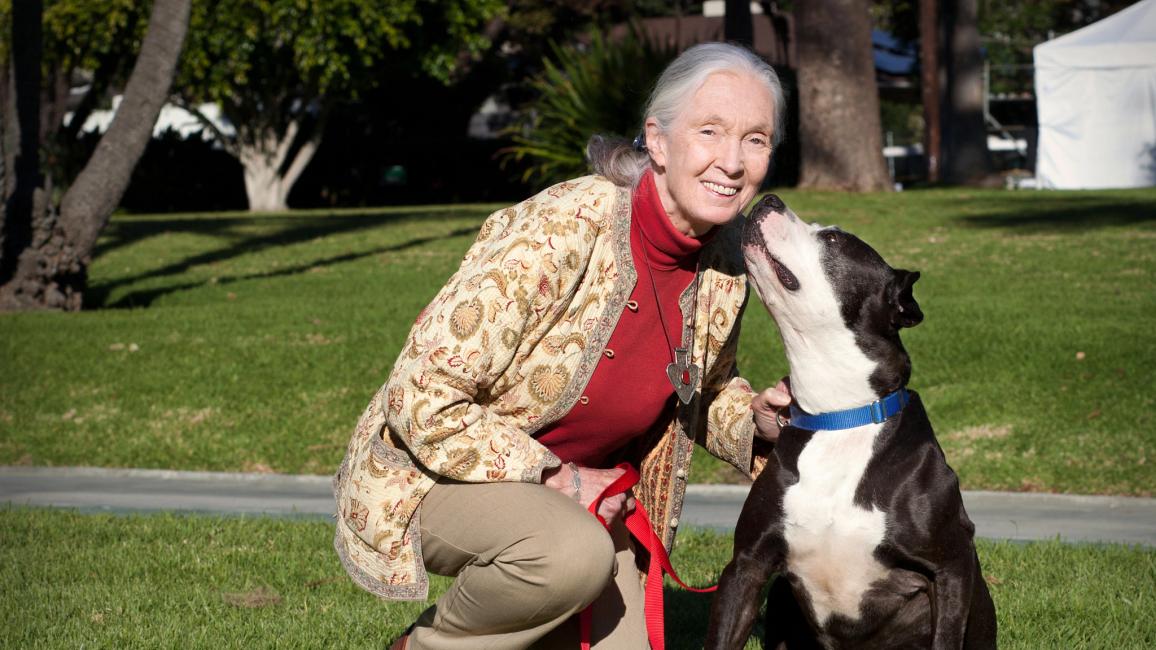
Jane’s world and that of Best Friends have much in common: both centered on kindness, compassion, and an understanding that the lives of animals have intrinsic value and are deserving of our respect and protection. As it happens, Best Friends co-founder Silva Battista had a connection to Jane through her sister-in-law, Mary Lewis, who was Jane’s assistant and traveling companion for decades. That relationship led to collaboration and mutual support between Jane, the Jane Goodall Foundation, and Best Friends. When she was invited to be the grand marshal of the Tournament of Roses Parade, her only condition was that adoptable dogs from Best Friends walk the parade route beside her grand marshal’s carriage. Jane supported us not out of obligation but from conviction. She believed in what we were doing, especially when it came to kindness as action, message, and mission. She didn’t just lend her reputation; she lent her heart, consistently, until the very end.
Jane’s life reminds us that kindness can be a compass. It can guide how we make decisions for animals, people, and communities alike. She showed us that using our voice and influence generously matters and that waiting for permission is rarely how the world changes. Case in point: Her support of Best Friends was never ceremonial. She came to our super adoption event in Los Angeles to promote pets for adoption. When we thought we might need her voice in our stand against a mining operation that posed an existential threat to the Sanctuary, she made a video to stand with us. She showed up. She believed. That generosity of spirit is what defined her.
In addition to founding the Jane Goodall Institute to advance the work she pioneered, she also created Roots & Shoots, an international youth organization that engages young people in local action to help animals, their communities, and the environment. Jane was also appointed a United Nations Ambassador for Peace and was awarded the United States Presidential Medal of Freedom.

In June of 2021, I had the honor of interviewing Jane for our Best Friends National Conference. I felt, in that moment, as if I were speaking with Mother Earth herself — or as the Cherokee people named her, “Sister of Mother Earth.” She had already turned the scientific world upside down by naming individual chimps — Fifi, Flo, David Greybeard — insisting they had personalities and emotions. That insistence was radical. It was anthropomorphism to her critics. But she knew, from her early life, that animals are more than data points.
When I spoke with her, she quoted her grandmother: “Once you’ve set your hand to the plow and turned back, you’re not fit for the kingdom of heaven,” she said with a laugh. She elaborated: “There’s a disconnect between this clever brain and the human heart where we poetically seek love and compassion. I truly believe head and heart must work in harmony.” And together they did — for she advanced the world scientifically by following that guiding compass of her heart and reached across arbitrary lines to listen and seek to understand others. She demonstrated to all of us just how strong we are together.
To the very end, she traveled 300 days a year, generously offering her influence where she could. This past week, she was on a speaking tour in California. Her life informed her legacy that will forever inform what we understand of the human–animal bond.

Jane spoke to each of us when she said that every day we make choices in our lives. All 8.2 billion (or so) of us make choices every day. By making these choices based on kindness, we can see the Earth revived. The courage it takes to stand up and preach harmony in the face of status-quo division is immense.
I will forever be grateful for the time I got to spend with Jane Goodall and for the work she has done for all beings on this Earth. Her absence will be felt deeply. In her memory, I charge you with remaining hopeful in the face of negativity. I charge you with listening to your heart to guide your mind and to do what’s right. And I’ll leave you with this: “What you do makes a difference, and you have to decide what kind of difference you want to make.”
Thank you, Jane, for devoting your life to a better world through kindness to animals.
-Julie