‘It would never work here’ until it does
By
Julie Castle
For as long as I’ve been in animal welfare, I’ve heard some version of, “That would never work here.”
And often, they’re right. Animal welfare isn’t a cookie-cutter world. Just like every dog or cat is completely unique, each shelter has its own path to success.
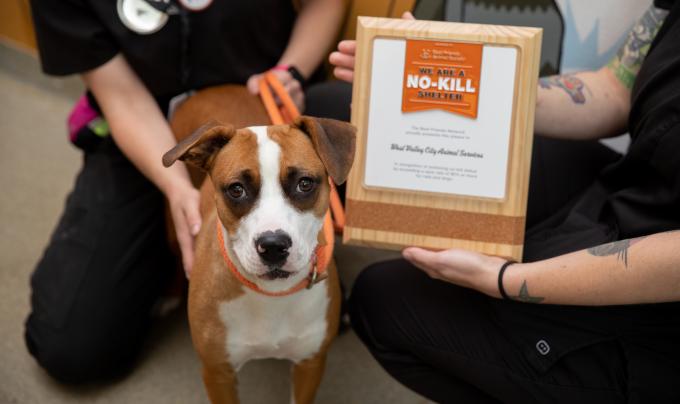
Over the past several weeks, we’ve been sending our annual celebratory plaques to shelters and rescue groups that achieved no-kill or sustained it in 2025, and now those plaques are hanging in lobbies and break rooms at shelters in towns you’ve heard of and a lot you haven’t. Going through the list of recipients, what strikes me isn’t what these organizations and places have in common; it’s how little they do.
What these communities show us is there isn’t just one way to achieve no-kill.
Take West Texas, where the range is so vast that you can get lost if you don’t have a partner working alongside you. One Tail at a Time-West Texas (OTAT) is a rescue group based in Marfa, and they earned a plaque this year on their own merit. But look at what else happened out there in the expanse of high desert in 2025.
Six of the shelters OTAT supports — municipal operations in Alpine, Marfa, McCamey, Pecos, Presidio, and Van Horn — saved 90% or more of the animals who came through their doors in 2025. More than 1,500 dogs and cats were saved across a stretch of country where distance travel is the defining factor of the work, where even the nearest grocery store is 120+ miles away.
This is what no-kill looks like — where there’s a will, there’s a way. They made do with what they had, and they did it together. (By the way, next week, I’m sharing a feature on Heather Hall, who runs OTAT-West Texas. Subscribe to my blog at the bottom of this page so you don’t miss it.)
Now, go about 2,000 miles east to Port St. Lucie, Florida. No desert here! Rather, you’ll find palm trees swaying and lawns that seem to be evergreen. Most distinctly different from West Texas: a neighbor is always just around the corner. But that’s not why we’re here.
The Humane Society of St. Lucie County, on Florida’s Treasure Coast, has been no-kill for seven straight years. With an active community, they can thrive. But this coastal community gets hit with some of the hardest conditions. Seven Atlantic hurricanes have blown through their town on top of shelter staffing crises and the pandemic. They’ve really had their work cut out for them. And anyone who has ever loaded crates into a van ahead of a storm can tell you that is not a rhetorical flourish.
Seven years is a long time to keep a promise that gets tested every single week, and thousands of dogs and cats have gone home because they kept at it — on quiet Tuesdays and chaotic Fridays and every other day in between.
And there’s Raskel’s Rescue in Hardeeville, South Carolina. They may be 30 minutes from a beach, but this small Lowcountry town off I-95 serving the greater Savannah, Georgia, area doesn’t boast a metro area population. But take a look at what they’ve built there, and you can see the place and the people they built it all for.
There’s a program for long-haul truckers looking for a dog to ride with –– I always picture the basset hound riding shotgun to Cledus in Smokey and the Bandit. There’s a food bank, so a family going through a hard stretch doesn’t have to give up a pet they love. There’s the Pink Project, which houses the animals of people leaving abusive homes until they’re safe enough to take them back. They work alongside animal control, they take the dogs who need months of rehabilitation before they’re ready for adoption, and they find homes for a goat or a horse or a few chickens while they’re at it.
Much of that work isn’t necessarily a national playbook, but it is a specific answer to their community. And it added up to a no-kill year for Raskel’s.
Now head up and over to Illinois in the Midwest. West Suburban Humane Society has been in Downers Grove since 1972, 20-some miles outside Chicago. It’s staffed by four full-time employees, 10 part-time employees, and more than 450 (!) volunteers. They care for about 200 animals at any given time, and they’ve sent more than 31,000 dogs and cats home over five decades — and in 2025, they achieved a 97% save rate.
Downers Grove doesn’t look too much like Hardeeville, Port St. Lucie, or Presidio. And West Suburban Humane Society’s path to no-kill looks nothing like anyone else’s either. But here, they built an institution the community was willing to show up for, and their community has continued to show up by the hundreds.
That’s what gets me so excited about these plaques. They get delivered to dozens of groups around the country that have been dealt their own unique set of challenges, yet they all arrived at that benchmark to no-kill.
There are proven strategies for no-kill, and every one of these organizations is using them — community cat programs, foster networks, spay/neuter initiatives, transport programs, keeping pets with the families who love them. But nobody reaches no-kill by running a template unchanged.
Each of these four organizations took what works and shaped it around the place they operate in, which is why a municipal shelter and its rescue partner in West Texas and a humane society in suburban Chicago arrived at the same result looking nothing alike. So when someone tells me their community is different, I believe them. Of course it’s different. Presidio is nothing like Downers Grove. That isn’t the reason no-kill can’t happen there. It’s the reason it gets built there by the people who know the place.

And one more thing: Look at what every one of these groups did the moment the plaque arrived. Not one took the credit. They passed it along immediately and instinctively, naming the staff who worked the holidays and the volunteers who showed up on their days off, the foster families who took the complex cases and the litters who arrived at 10 p.m. The adopters who said yes, the rescue partners who opened a spot when one was needed, the neighbors who gave a dollar because a dollar was what they had.
Read enough of these posts, and you stop seeing separate announcements and start seeing one continuous master class on how lifesaving actually happens. It’s never in a single building and never by a single organization but across a whole web of people who each carried some piece that not one of them could have carried alone.
To every shelter that got one of these plaques this year: Hang it somewhere you and your team walk by every day. You earned it in a place that was never going to be easy, and you did it your way. And to every shelter still working toward their no-kill achievement, keep going. A lot of people are pulling for you. Every dog and cat you got home this year is another life saved and another family made. And that counts for everything. Your no-kill year is coming.
Now let’s keep saving lives.
-Julie