Tiny chairs, big comfort: Volunteer builds joy for cats
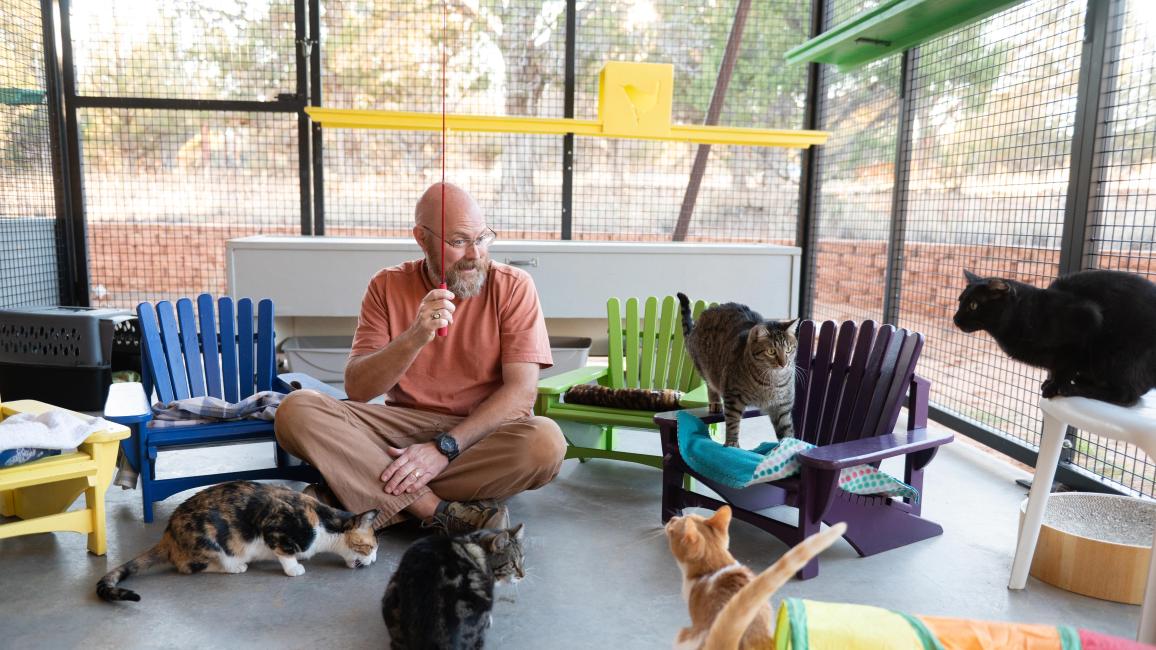
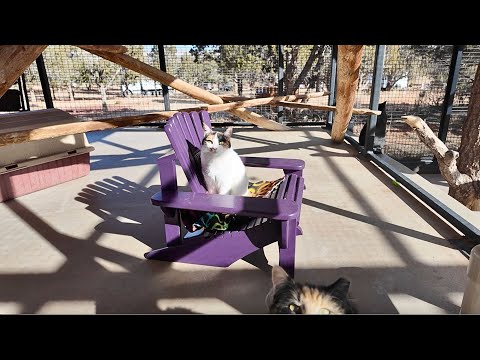
Sunlight spills across the catio, warming the fur of a content kitty curled in a miniature Adirondack chair. The chair’s slatted back and wide armrests look just like the full-sized version — only scaled down for feline comfort. Several more chairs dot the space, their cheerful colors bright against the soft desert backdrop of Best Friends Animal Sanctuary in Kanab, Utah.
Nearby, a pair of wooden daybeds invite lazy stretches and afternoon naps. Cats lounge in every direction: one sprawled belly-up in the sun, another tucked neatly into a chair’s curve, eyes half closed in bliss. It’s a scene of pure relaxation, made possible by a volunteer’s creativity and a pile of leftover wood scraps.

A labor of love
Just a few miles away from the Sanctuary in a cozy workshop, saw blades whir, hammers pound, and drills buzz — not quite the sounds one might expect when thinking of volunteering to help animals. But for Curtis McIff, woodworking has become a labor of love — and a comfy gift to the cats at the Sanctuary.
Best Friends’ goal is for all shelters nationwide to reach no-kill, and people who step up to volunteer — either directly with the animals or in other roles — play a vital part in reaching that goal.
[4 volunteers helping animals in unique ways]
As a way to keep busy in retirement — in addition to all the volunteering he does — Curtis picked up woodworking. “I made some chairs for my house — just some Adirondack chairs — and I looked at the scraps and wondered if I could do something with them,” Curtis says. With that, an idea sparked. Soon, he had taken the dimensions for the chairs he built and made them cat sized.
Curtis crafted a smaller version of the Adirondack chairs for his cats, but he didn’t stop there. Curtis and his wife immediately thought of how those chairs might benefit the cats at Cat World — the area of Best Friends Animal Sanctuary where cats from shelters all across the country come for special care and to be placed in new homes. Not long after this, he had boards stacked neatly in sets for chairs, each piece labeled and ready for assembly.
And the first few chairs were extra special.

Building comfort, one chair at a time
“The first six I made went to Colonel’s Barracks, and each room there is a different color. So I made each one to match the room it would go into,” he explains.
The Colonel’s Barracks is the largest of the Cat World buildings with room for about 100 cats. It houses cats who need a little extra help with behavior issues.
When Curtis volunteered in Cat World, he spent most of his days at the Colonel’s Barracks. So his first set of gifted chairs felt like an extra special delivery for the cats. “It does my heart good to see them facing the sun while lying in one of my chairs,” Curtis says warmly.
[13 stories of volunteers who save pets’ lives]
Curtis didn’t stop at chairs though. “It was actually a caregiver from Cat World who asked me if I could make a little cat bed,” Curtis says. After the caregiver showed Curtis a picture of a small cat daybed, he worked to design some he could build. The results were beautiful and thoroughly enjoyed by snoozing cats.
Since starting, Curtis has built 40 mini Adirondack chairs and 10 cat daybeds. “I try to donate more each year, especially around Christmas. It’s like our little Christmas gift to the cats,” he says.

Small chairs, big impact
Curtis now spends much of his volunteer time at the Sanctuary in Dogtown (the area where the dogs live). But he often takes detours to see the cats lounging in his creations. “I enjoy doing these little things for them even when I’m not at the Sanctuary,” he says.
Every piece Curtis builds is more than wood and screws; it’s a gesture of care that ripples through the Sanctuary. Volunteers like Curtis bring us closer to a future where every pet has a safe, loving place to rest. And for the cats lounging in their Adirondack chairs, that future feels a lot more comfortable.

Let's make every shelter and every community no-kill
Our goal at Best Friends is to support all animal shelters in the U.S. in reaching no-kill. No-kill means saving every dog and cat in a shelter who can be saved, accounting for community safety and good quality of life for pets.
Shelter staff can’t do it alone. Saving animals in shelters is everyone’s responsibility, and it takes support and participation from the community. No-kill is possible when we work together thoughtfully, honestly, and collaboratively.
You can help save homeless pets
You can help end the killing in shelters and save the lives of homeless pets when you foster, adopt, and advocate for the dogs and cats who need it most.


Saving lives around the country
Together, we're creating compassionate no-kill communities nationwide for pets and the people who care for them.

Let’s be friends!
Connect with us on social media to stay in the loop about the lifesaving progress we’re making together.


