Finding nontraditional homes for Alaska cats
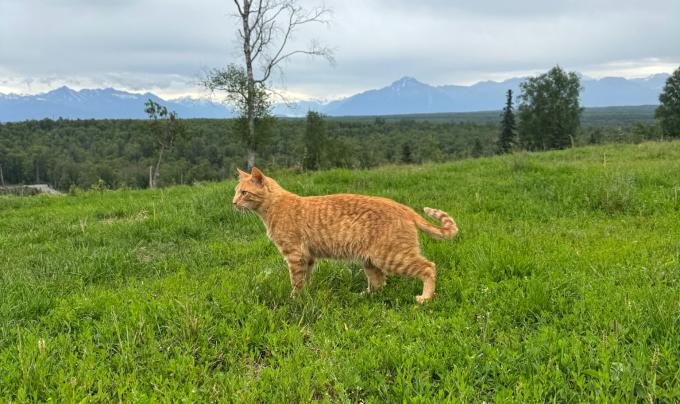
For some rescued cats, their happily-ever-after involves lounging on a comfy perch by the sunniest window in the house, batting around crumpled pieces of paper (and not those fancy cat toys you bought), and curling up on their person’s lap. For Milo, happily-ever-after means hanging out with some piglets and cows.
When the handsome orange tabby first arrived at Kenai Animal Shelter, a Best Friends Network Partner in Alaska, he loved the company of other cats but did everything he could to keep people at a distance, hissing, swatting, and growling whenever someone came close. The shelter staff knew he may never be someone’s lap cat. But he was an ideal candidate for Clear Creek Cat Rescue’s barn cat program.
Clear Creek Cat Rescue, another network partner in Alaska, works closely with Kenai Animal Shelter to help cats like Milo who aren't likely to thrive in traditional indoor homes. Instead, they work to find these cats safe homes at barns, ranches, warehouses, and other properties. Not only is it good for the cats, but people appreciate that cats tend to deter rodents.
“Some of these cats just aren't going to be happy living as house cats,” says Kelleigh Orthmann, a longtime volunteer with Clear Creek. “These cats just need a different kind of home.”

‘House Hunters,’ feline edition
Helping cats like Milo land in those different types of homes is a team effort.
“The difference that individual people or organizations like Clear Creek can make to a community and to municipal animal shelters is huge,” notes Ainsley Hay, a Best Friends strategist who works in the region. “Sharing the responsibility of finding new homes for animals who have a hard time in traditional adoption programs is so important.”
And with support from Best Friends, Clear Creek is helping even more cats move into homes that fit them best. The rescue group recently received a Rachael Ray Save Them All Grant from Best Friends, allowing the group to expand its barn cat program. Grants like these are just one of the ways Best Friends is helping shelters nationwide reach no-kill.
“It's a free-of-charge program,” says Kelleigh. “We give people cats to help keep the pests down, and the grant helps cover the costs of getting the cats spayed or neutered, microchipped, vaccinated, and ready to go out the door.”
The grant also helps provide adopters with the supplies their new cats need to settle in, including food and litter, scratching posts, heated kitty houses, and heated water bowls.
“We make sure they have plenty of toys, too,” adds Kelleigh. “They’re still just cats who love to play. Some of our adopters have trail cams out in their barns to check in on the cats, and at night the cats are so silly. They bounce around and play when they think nobody is looking.”
Home on the range
Before bringing cats to their new homes, Clear Creek volunteers visit each property to help the adopters identify safe buildings where the cats can settle in.
“We like to try to keep them contained for two to three weeks, so they get to know their new home,” Kelleigh explains. “Then, they can roam around the barn and out into the areas where the horses or cows or chickens are.”
A brighter future for community cats in Las Vegas
She adds that whenever possible, the cats are adopted in pairs or small groups, giving them a familiar companion as they settle into their new home.
In a state like Alaska, where programs like this are rare, Clear Creek's barn cat program gives cats who aren’t suited for traditional homes another path forward. It’s also helped Kenai Animal Shelter maintain a save rate (the percentage of animals who leave a shelter alive or are still there waiting for an outcome) of 90% or higher — the benchmark for no-kill — for the past year.

One clowder of cats, please
For Milo, that path led to life on a sprawling ranch in Wasilla, Alaska — 200 miles north of the Kenai Peninsula. Today he shares his home with piglets, cows, six other barn cats, and a family who appreciates him exactly as he is.
“We've learned what he likes and what he doesn't,” says Milo's adopter. “He seeks us out for attention now, but if he's not in the mood, we just leave him alone. I think he just fits in well with the flexibility to do whatever he wants.”
Helping community cats thrive in California
For a cat who once spent his days ready to hiss and swat, landing in a home that lets him be himself turned out to be exactly what he needed.
“He’s happy as a clam in his new home with the pigs, cows, and his own little clowder (group) of cats," Kelleigh says. “It's a second chance at life for him.”
Let's make every shelter and every community no-kill
Our goal at Best Friends is to support all animal shelters in the U.S. in reaching no-kill. No-kill means saving every dog and cat in a shelter who can be saved, accounting for community safety and good quality of life for pets.
Shelter staff can’t do it alone. Saving animals in shelters is everyone’s responsibility, and it takes support and participation from the community. No-kill is possible when we work together thoughtfully, honestly, and collaboratively.
You can help save homeless pets
You can help end the killing in shelters and save the lives of homeless pets when you foster, adopt, and advocate for the dogs and cats who need it most.


Saving lives around the country
Together, we're creating compassionate no-kill communities nationwide for pets and the people who care for them.
Get inspiring animal rescue stories delivered straight to your inbox
Never miss a feel-good animal story. When you give us your email, we’ll send you inspiring animal rescue stories each week, along with tips on different ways you can help save homeless pets in your community and beyond.